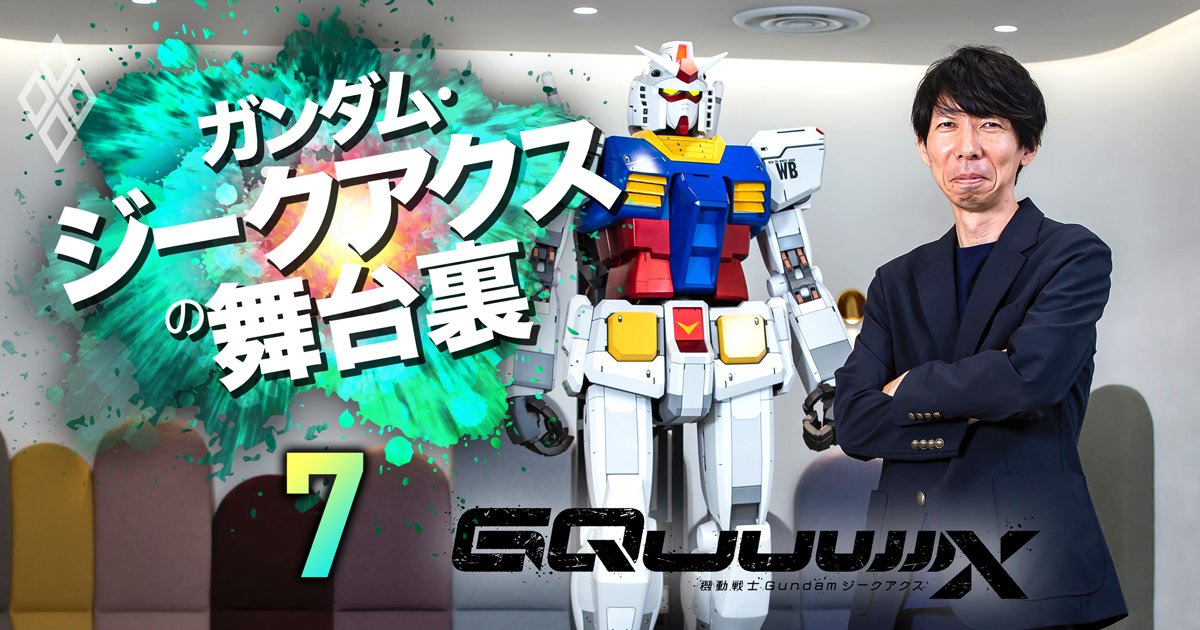
BEHIND-THE-SCENES OF GQuuuuuuX #7
Gundam GquuuuuuX Succeeded Precisely Because It’s Gundam’s “46th Year”
Even Tomino Himself Has Watched It
Interview with Naohiro Ogata, Executive Director, Gundam Business Division, Bandai Namco Filmworks (Part 1)
Gundam GquuuuuuX has become a monumental work in every sense of the word. Born from an unprecedented partnership between Studio Khara and Bandai Namco Filmworks (BNF), many have wondered how this collaboration came to fruition. In this seventh installment of our special behind-the-scenes series on Gundam GquuuuuuX (planned for 13 parts), Naohiro Ogata, head of BNF’s Gundam Business Division, provides in-depth insights into this groundbreaking collaboration.
SECOND HIGHEST BOX OFFICE REVENUE IN GUNDAM FILM HISTORY
COLLAB WITH KHARA CAPTURES NEW CUSTOMER DEMOGRAPHICS,
REVIVES DORMANT FANBASE
――Looking back on the entire GquuuuuuX project as the head of Bandai Namco Filmworks’ Gundam division, how would you summarize its achievements?
Everyone has been incredibly pleased with it, and we’ve received feedback that exceeded our wildest expectations. Working alongside Studio Khara, we managed to attract a completely new demographic that previous Gundam projects had struggled to reach, and crucially, we also successfully brought back our core audience, fans aged 50 and above, who had become dormant. We surpassed all quantitative targets: viewership ratings, streaming replay counts, and merchandise sales, which are core to Gundam’s business model, all achieved outstanding results. The TV series concluded on a high note.
The theatrical release, preceding the television broadcast, also exceeded our expectations. Thanks to an extended theatrical run and additional screenings, box office revenue has reached ¥3.58 billion. Among Gundam films, this ranks second only to 2024’s Mobile Suit Gundam SEED FREEDOM, which brought in ¥5 billion. Considering that SEED was an original standalone theatrical release, it’s particularly remarkable that a film essentially previewing a TV series could achieve such numbers. It’s truly thanks to the passionate support from fans.
――As an executive producer, what specific strategies did you use for promoting and driving interest in GquuuuuuX? For instance, why did you choose to release it theatrically ahead of the TV broadcast?
Preceding the television broadcast with a theatrical release isn’t entirely new, Demon Slayer: Mugen Train adopted this approach, as did Gundam itself with Yoshiyuki Tomino’s Gundam Reconguista in G, which received event-style theatrical screenings. So while this wasn’t the first time, we had several strategic reasons behind adopting this approach.
The primary benefit was being able to build significant awareness before the TV broadcast began. We could run commercials on TV, place outdoor advertisements, and use highly visible train ads, such as those on Tokyo’s JR Yamanote Line. While box office revenue was obviously important, our main objective was to establish strong recognition for the series ahead of its television debut.
However, the massive success at theaters and the buzz it created came largely from Khara’s brilliant idea: they suggested starting the theatrical version with episodes one and two of the TV series, a thrilling alternate scenario where Char steals the Gundam, echoing the very first Gundam series. Khara structured this specifically to captivate and surprise audiences, and their keen understanding of what excites viewers paid off spectacularly.
Gundam GquuuuuuX is indeed an unprecedented Gundam project, created entirely by an external studio, Studio Khara. On the 46th anniversary year of Gundam, Bandai Namco Filmworks took this bold and surprising step. Ogata explains why BNF decided to pursue such an innovative strategy and reveals the existence of “another planned project” prior to GquuuuuuX. Moreover, Ogata shares what Yoshiyuki Tomino, the original creator of Gundam, thought of the new series.
ANOTHER PROJECT PROPOSAL ACTUALLY EXISTED, EVEN DIRECTOR TOMINO HIMSELF HAS WATCHED
A GUNDAM CONCEPT ONLY POSSIBLE IN ITS 46th YEAR
――Viewers were amazed, frequently commenting, “I went to see Gundam, and suddenly Gundam started happening!” It was an unexpected experience. But why collaborate with an external studio like Khara?
Partnering with an external studio for a mainline Gundam series was completely unprecedented until GquuuuuuX.
As Director Tsurumaki mentioned in his earlier interview (Part 1 of this series), the project began around 2018, initiated by a fortunate connection with Producer Yuki Sugitani, who collaborated with us on Mobile Suit Gundam Unicorn. At that time, besides Unicorn, I was also involved with OVAs and films like Mobile Suit Gundam Hathaway, Gundam NT (Narrative), and Mobile Suit Gundam Thunderbolt, but it had been some time since we produced a Gundam TV series, with Mobile Suit Gundam: Iron-Blooded Orphans wrapping up in 2015.
It was around this period that our entire group discussed the future direction of Gundam, strategizing how to create new content and attract younger audiences. Sunrise Studio has continually produced alternative series like SEED and Gundam 00 specifically to attract new fans and introduce Gundam to successive generations, a goal we have firmly maintained throughout Gundam’s 46-year history.
Our core demographic naturally centers around Generation X, fans in their 50s who first experienced Gundam during the elementary school Gundam model kit boom. These viewers later became too busy with middle school activities, drifting away from anime, but many returned during university years or thereafter. We’ve continuously produced films and other content specifically for this loyal yet fluctuating demographic.
However, our television strategy aimed explicitly at younger audiences, hoping to create something contemporary viewers could call their own Gundam. This was our foundational concept. To deliver on this, we chose directors capable of resonating deeply with younger viewers, Hiroshi Kobayashi for The Witch from Mercury and Kazuya Tsurumaki for GquuuuuuX.
Through our relationship with Producer Sugitani, we recognized Director Tsurumaki’s proven talent in creating compelling works for young audiences, FLCL, Diebuster, The Dragon Dentist, and of course, Evangelion. We directly asked Sugitani if Tsurumaki could create a Gundam series aimed at a new audience. Sugitani coordinated the effort at Studio Khara. From the outset, we specifically approached Tsurumaki rather than Hideaki Anno (Khara’s president).
――GquuuuuuX blends homage and reinterpretation, elements that might draw criticism from longstanding, passionate fans. Was there apprehension from your side or Tsurumaki’s side? What led you to proceed despite the risks?
After discussions involving Anno, Tsurumaki, Sugitani, and our team, Tsurumaki presented us with two proposals. One was GquuuuuuX, and the other, a completely different concept that I can’t disclose. Although both had appeal, GquuuuuuX felt distinctly more captivating, compelling us to select it.
We anticipated varied reactions, from fans, creators, and industry professionals who have devoted years to Gundam. But the primary reason we could confidently pursue such a daring idea now is Gundam’s longevity, marking its 46th anniversary this year. This extensive history has deepened Gundam’s content and IP. Multi-generational fans have matured, exemplified by families visiting Odaiba to see the life-sized Gundam statues. Without this matured fandom, such a bold initiative would have been impossible, certainly inconceivable 20 years ago.
Given the inherent risks, Tsurumaki and our team carefully navigated every decision. We engaged in extensive dialogue to garner understanding across the board and meticulously managed media communication right up to the series finale.
――Speaking of important stakeholders, what about Yoshiyuki Tomino himself? Has he watched GquuuuuuX?
Tomino rarely watches Gundam series directed by others. Of course, we always brief him on projects, but ultimately, he decides independently whether to watch. I heard he did watch GQuuuuuuX. And as he always does, Tomino considers every other Gundam director a rival, and he approached this viewing with his usual competitive mindset. Interestingly, he hasn’t met with every Gundam director personally; he hasn’t met Tsurumaki yet.
TO BE CONTINUED IN INSTALLMENT #8