BEHIND-THE-SCENES OF GQuuuuuuX #1
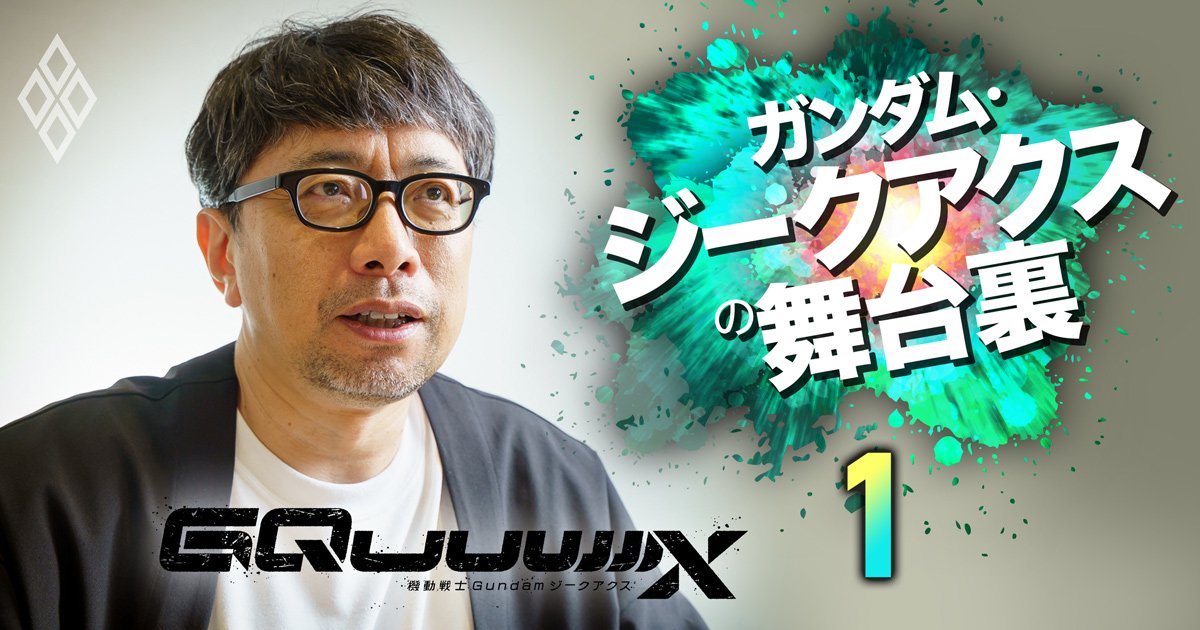
Only Studio Khara Could Tackle GQuuuuuuX: What Started Conservatively Accelerated and Became Unstoppable
Interview with Director Kazuya Tsurumaki (Part 1)
Gundam GquuuuuuX, the latest installment in the Gundam franchise. Crafted by Studio Khara, the studio behind the Evangelion series, it’s a parallel world setting that extensively pays homage to Mobile Suit Gundam, the first series that aired on television in 1979. Released theatrically ahead of its television debut, the series swiftly garnered widespread acclaim and became a cultural phenomenon. In our special feature, Behind the Scenes of Gundam GQuuuuuuX, director Kazuya Tsurumaki revisits the project’s inception and development now that the broadcast has wrapped.
A COLLAB THAT BEGAN DURING SHIN EVA’S PRODUCTION,
CREATED BY A TEAM OF UNIVERSAL CENTURY GUNDAM OTAKU
――Gundam GquuuuuuX became a cultural sensation, drawing enormous attention following its January 2025 theatrical release. Even its late-night March TV premiere captivated business professionals in their 40s and 50s, igniting nonstop discussions on social media. Can you tell us again how Studio Khara ended up creating this iteration of the iconic, 45-year-old Gundam IP?
The project began around 2018, kicked off by producer Naohiro Ogata from Sunrise Studio (Bandai Namco Filmworks Sunrise Studio), who approached our producer, Yuki Sugitani. At the time, Sugitani was assisting with Mobile Suit Gundam Unicorn during a hiatus in Shin Evangelion’s production. Ogata asked Sugitani if, post-Evangelion, Khara might be interested in producing a Gundam series. Sugitani then requested a proposal from me.
My initial reaction was that the responsibility felt immense. However, motivated partly by gratitude for Sugitani’s significant efforts in production management, I agreed to submit a proposal as a desire to reward his hard work.
――You’ve personally been a fan of Gundam for a long time?
Gundam is a massive franchise with an extensive fan base among men in their 20s to 60s. While I wouldn’t say I’m an expert in every alternate Gundam series like SEED or 00, I am undeniably passionate about the Universal Century timeline. At Khara, even President Hideaki Anno has edited a fan magazine dedicated to Mobile Suit Gundam: Char’s Counterattack. Indeed, our creative team, led by screenwriter Yoji Enokido, is thoroughly composed of dedicated Gundam enthusiasts.
Although GquuuuuuX has frequently been praised for its detailed homage to the original Gundam, it began quite differently. Director Tsurumaki discusses how Hideaki Anno became involved and how the project evolved into its current form.
AN EXTERNAL STUDIO’S BOLD ALTERNATE HISTORY:
STARTING QUIETLY, THEN RACING UNCONTROLLABLY AHEAD
――The premise of GquuuuuuX is strikingly bold: a world where Char Aznable steals the Earth Federation’s new Gundam, repaints it red, and leads Zeon to victory in the One Year War. Your meticulous recreation of iconic scenes from the first episode of the original 1979 Mobile Suit Gundam, down to dialogue and visuals, while simultaneously presenting an entirely opposite narrative outcome (in both the theatrical release and the first two TV episodes) was a huge talking point. What inspired this particular approach?
While future Gundam series might similarly emerge from external studios, it was unprecedented at the time to entrust mainline Gundam anime production to an outside studio. Given this opportunity, we proposed something Sunrise itself might hesitate to explore, an alternative history where Zeon triumphs.
Initially, we suspected Sunrise anticipated something more Evangelion-like from Khara. Instead, they received an unexpected pitch exploring a parallel Universal Century timeline. We assumed it might be rejected outright, but surprisingly, it got approved.
From the start, we intended Challia Bull, who barely appeared in the original series, as a central character. There’s a play by Samuel Beckett called Waiting for Godot, and I initially thought to portray Char with that feeling, where Godot, who never appears once in the play, is at the center of the story. Only at the beginning of episode 1 would Char appear, and the part where he steals the Gundam would be depicted in the opening pre-title sequence, then we’d jump to the era when the main story unfolds and depict episodes after that. I envisioned a form where only Char’s disappearance and the reasons for his disappearance would be discussed within the episodes.
Yet, as the project evolved, Char’s role significantly expanded, becoming deeply woven into the narrative. Once the momentum built, we couldn’t stop (laughs).
――GquuuuuuX blends homage and reinterpretation, elements that might draw criticism from longstanding, passionate fans. Was there apprehension from your side or Tsurumaki’s side? What led you to proceed despite the risks?
After discussions involving Anno, Tsurumaki, Sugitani, and our team, Tsurumaki presented us with two proposals. One was GquuuuuuX, and the other, a completely different concept that I can’t disclose. Although both had appeal, GquuuuuuX felt distinctly more captivating, compelling us to select it.
We anticipated varied reactions, from fans, creators, and industry professionals who have devoted years to Gundam. But the primary reason we could confidently pursue such a daring idea now is Gundam’s longevity, marking its 46th anniversary this year. This extensive history has deepened Gundam’s content and IP. Multi-generational fans have matured, exemplified by families visiting Odaiba to see the life-sized Gundam statues. Without this matured fandom, such a bold initiative would have been impossible, certainly inconceivable 20 years ago.
Given the inherent risks, Tsurumaki and our team carefully navigated every decision. We engaged in extensive dialogue to garner understanding across the board and meticulously managed media communication right up to the series finale.
――Char ended up being central rather than absent, with his introductory sequence eventually becoming long enough for a standalone film. Even Hideaki Anno contributed to the script.
Our opening sequence, originally just the theft of Gundam, grew too lengthy for a TV episode. Separating it as a standalone film solved this, and Anno eagerly scripted it, enthusiastically adding bold sequences. He suggested thrilling battles between Char’s stolen Gundam and Federation mobile suits, scenes I initially considered unnecessary. But upon reading Anno’s drafts, we thought, “Fans would absolutely love this.” Consequently, the story grew even longer (laughs).
Initially, we approached the series cautiously. Yet eventually, iconic original characters became integral, which raised concerns about creating something too akin to fan-fiction.
Still, I’ve always believed fan works are often the first steps toward true creativity. Like my earlier series FLCL, creative works often emerge from homage or influences of past creations. Most creators, barring rare geniuses, rarely invent from absolute scratch. Although people avoid publicly admitting it due to copyright concerns, it’s quite common.
Gundam’s vast legacy offers abundant storytelling resources. Ignoring these felt like leaving perfectly good weapons unused and opting to fight with handmade sticks instead. Perhaps Sunrise couldn’t have comfortably done it themselves, but coming from an external studio like Khara, we figured we could be forgiven.
There’s no shame in being called fan-like, especially when it benefits Sunrise themselves, and thankfully, they were open to this approach.
TO BE CONTINUED IN INSTALLMENT #2