
GUNDAM: BREAKING NEW GROUND THROUGHOUT SOCIETY
GUNDAM BUSINESS SOARS EVER SKYWARD: EDUCATION, RESEARCH, WORLD EXPOS…
BREAKING NEW GROUND THROUGHOUT SOCIETY
Hiroshi Sakakibara
Chief Gundam Officer (CGO) and President of BANDAI SPIRITS
We sat down with Hiroshi Sakakibara, the Chief Gundam Officer who orchestrates the comprehensive strategy behind Gundam business, an intellectual property empire that has swelled to 160 billion yen across the entire Bandai Namco Group, exploring the IP’s inherent strengths and challenges, as well as the expanding movement to harness Gundam’s potential in societal spheres including education, research initiatives, and world expositions.
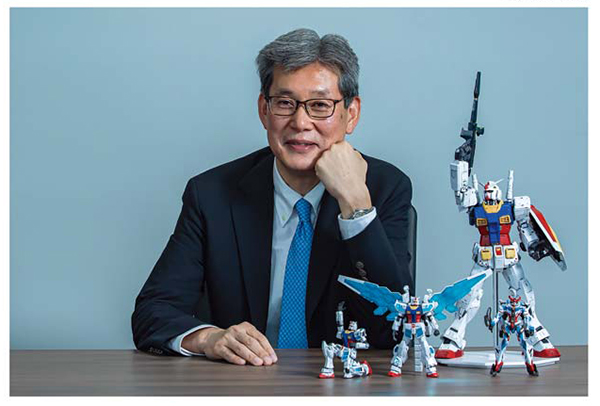
――Within the Bandai Namco Group, only three positions bear character names (the others being Chief Tamagotchi Officer and Chief Pac-Man Officer). What exactly does your role as Chief Gundam Officer entail?
The Chief Gundam Officer position was established in 2003. The inaugural CGO was Kazunori Ueno, who later ascended to become Bandai’s president in 2005, making me the fourth to hold this mantle.
My primary mission is to maximize the brand value of Gundam, one of the few original IPs within the Bandai Namco Group. To that end, I oversee the Gundam Project (G-Pro), launched in 2003, which coordinates medium- to long-term strategies across the entire group.
G-Pro brings together heads of various Gundam-related units, covering video productions, toys, games, and music, to share updates, synchronize themes for future projects, and determine optimal marketing strategies. Elevating Gundam’s IP value requires simultaneous excellence in both storytelling and merchandise. While Bandai Namco Filmworks produces compelling new content, it’s equally crucial to expand consumer touchpoints across core products such as Gunpla, games, toys, and confections.
――Could you summarize the broader business impact of Mobile Suit Gundam GQuuuuuuX on Gundam-related merchandise sales and other aspects?
The Gundam business itself has experienced steady growth in recent years, driven mainly by strong sales in collectible products, particularly plastic models. Regularly releasing new content has significantly boosted sales. It’s a synergistic cycle: compelling shows drive product sales, and popular products reinforce viewer engagement.
GQuuuuuuX, in particular, succeeded in reaching new customer demographics, a key objective for any Gundam series. Additionally, we’ve re-engaged dormant fans who had stepped away from the franchise, giving us a tangible sense of renewed engagement reflected directly in merchandise sales.
Notably, TV commercials during GQuuuuuuX featured scenes of women building Gunpla, reflecting our increasingly diverse consumer base. Following The Witch from Mercury, which featured a female protagonist, our current vision embraces a genuinely diverse, all-age and gender-inclusive Gundam audience.
――Gundam IP revenue within the Bandai Namco Group rose from 68.3 billion yen in March 2016 to 153.5 billion yen by March 2025, more than doubling in eight years. What factors contributed to this growth?
This remarkable increase is primarily due to the synergistic effects of consistent, high-quality productions, expanded manufacturing capacity, and diversification of product categories. Unlike many other IPs, Bandai Namco Group manages all aspects, licensing, video production, and product distribution, internally. Frequent G-Pro meetings facilitate rapid and thorough information sharing, giving Gundam a unique advantage in conceptual alignment and speed-to-market.
In my view, Gundam’s longevity over 45 years is largely due to its diverse offerings. Fans connect to different “First” Gundams depending on their generation or region, unlike IPs that maintain a single protagonist throughout. Whether it’s Amuro or another character entirely, the broad range of protagonists allows Gundam to attract diverse audiences continuously.
Moreover, fans drawn to new characters, such as viewers who became invested in Machu from GQuuuuuuX, often revisit older series like the original Mobile Suit Gundam. This unique cross-generational appeal makes Gundam an unusual yet potent IP. Our job is to effectively integrate this appeal into marketing strategies, linking engaging content with appealing merchandise.
“GUNPLA CLASSROOMS” IN ELEMENTARY SCHOOLS WORLDWIDE AND DOMESTICALLY:
NEXT-GENERATION EDUCATION SPARKED BY GUNDAM
――There have been concerns that the shortage of Gunpla supply is hindering the growth of the Bandai Namco Group. How do you plan to address this?
Gunpla remains in short supply, causing inconvenience to some customers. However, with over 5,000 different products available across our catalog, we manage production and sales plans according to market demand. Still, sales have consistently exceeded even increased production capacities, not just due to Gundam’s 45th anniversary but ongoing demand.
The Gunpla manufacturing process utilizes two distinct machine types: single-color molding machines that produce runners (the framework where plastic model parts are formed) in one color, and multi-color molding machines that employ our group’s proprietary technology. Both require specialized personnel, making rapid scaling challenging. Despite continuous investment, the most significant recent effort is our second factory, the Bandai Hobby Center Plamo Design Industrial Institute (BHC PDII), operational since July 24th. Planned several years ago, PDII will reach full capacity by summer 2026, increasing production by 35% compared to 2023.
Gunpla production is complex, involving injection molding, component assembly, and mold-making. While 75% of our production occurs in the Shizuoka, though not all processes are completed in-house. The PDII is an innovative, all-in-one factory covering molding to final assembly. In September, we’re opening a Gunpla Museum, allowing visitors to observe the production process firsthand.
――Are Gunpla-style products uncommon overseas?
Plastic model kits exist internationally, but our method, using multi-color molding machines, pre-colored parts, and glue-free assembly, is unique. To promote this globally, we’ve launched model-building classes in North America and Europe, similar to events we’ve long held in Asia.
Domestically we’ve taken it even further with “Gunpla Academia,” plastic-model classes delivered as part of elementary-school lessons. Teachers at public and private elementary schools nationwide can apply, and we typically target fifth-grade classes to teach plastic-model building as part of the school day. Launched in 2021, the program has reached 12,033 schools with approximately 827,000 student participants (cumulative, as of July 28).
The goal is to let children experience creating three-dimensional objects, take a virtual factory tour of the plastic-model production process, and, after they finish building, learn about recycling by seeing how runners are collected and what they become.
When a school applies, assembly kits, teaching materials, and videos are shipped free of charge for classroom use. We started this with the hope that it would spark future interest in manufacturing and engineering. Plastic models are enjoyed by all children, regardless of gender, so if this becomes a touchpoint that draws kids to Gunpla and plastic models, we’re grateful.
――Another example of “Gundam stepping out into society,” then. Another notable example was the Gundam Global Challenge, the moving, life-size Gundam displayed in Yokohama.
It was a collaborative effort with robotics and engineering researchers marking Gundam’s 40th anniversary. Continuing this initiative is the Gundam Open Innovation showcased within the GUNDAM NEXT FUTURE PAVILION at Osaka’s Kansai Expo.
The purpose is to use Gundam as the spark to inspire the next generation to take an interest in future technologies, space, and aerospace engineering, and to provide a stage for showcasing related technologies.
For example, Gundam often depicts tight spaces such as space colonies, rocket interiors, and the like. We’re exhibiting “expanded-space” technologies that make confined environments feel more spacious. And because you can’t use pesticides in space agriculture, we’re presenting, together with academic researchers, technologies that cultivate rice and other crops with reduced pesticides by harnessing plasma particles based on the beam saber’s operating principle.
By leveraging Gundam, we aim to ignite young people’s curiosity across various fields, embodying true sustainable business practices. Our ongoing mission remains creating products and stories that resonate with customers, ensuring Gundam continues to represent the pinnacle of “cool” in each era.
Source: Diamond Weekly 8/30 Issue (Pages044-045)