WHAT’S REALLY HAPPENING NOW? Fukui x Tomino
IMPORTANT NOTE: I shouldn’t have to point this out, but given the keyboard warrior mentality of the fandom towards creatives, disclaimers are necessary. This is a conversation from 2004. Read that date again before smashing keys, please.
What’s Really Happening Now?
The World in Chaos, Japan in Confusion, and the Hopes Placed in Zeta
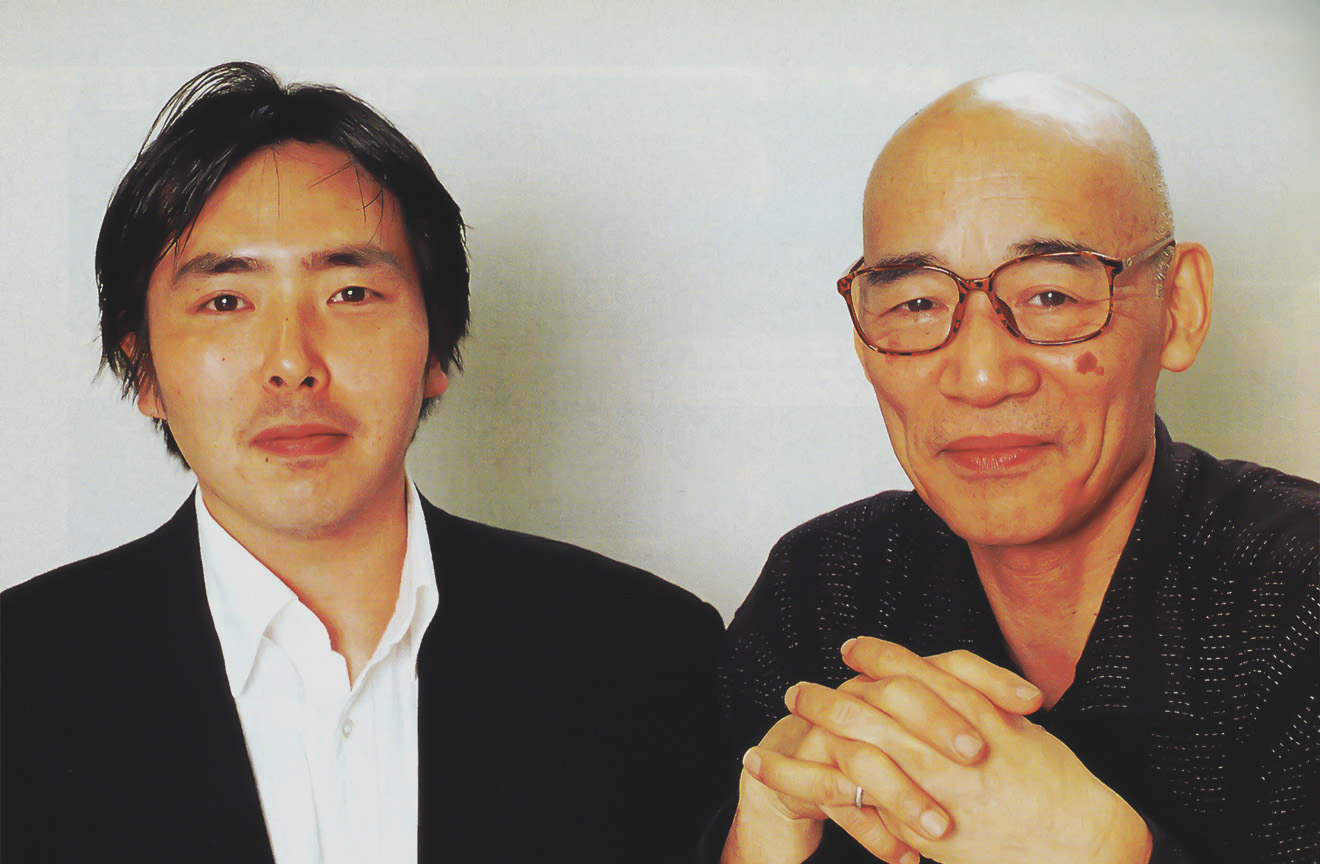
HARUTOSHI FUKUI ASKS YOSHIYUKI TOMINO!
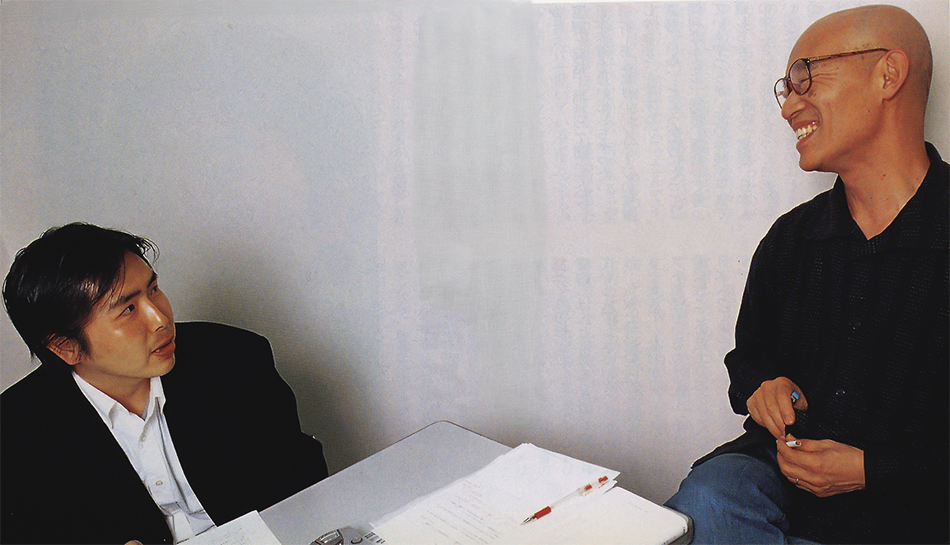
Even after Hussein was captured, the situation in Iraq has only worsened by the day. With every new revelation of horrors, the world trembles once more. How did things come to this? And what is our responsibility now? Ahead of next spring’s release of the film Lorelei, adapted from the novel Lorelei at the End of the War, its author Harutoshi Fukui sat down with Director Yoshiyuki Tomino to speak, at length and in depth, about the storm of international turmoil and the coming of Zeta Gundam to the big screen.
Photography by Chisato Hikita | Text & Interview by Nozomi Omori
THE DEPLOYMENT OF THE SELF-DEFENSE FORCES TO IRAQ IS ABOUT OIL
Fukui: Recently, among the younger generations especially, I sense an eruption of almost reflexive anti-American sentiment. It feels as if “anti-war” and “anti-American” have become interchangeable terms, used side by side without any careful distinction. The response to the recent hostage crisis in Iraq revealed something striking: a few years earlier, the nation might have erupted in moral outrage, championing the primacy of human life, but this time words like “personal responsibility” surfaced instead, and Japan’s collective reaction seemed surprisingly cool-headed. Yet, on the other hand, beneath this surface calm, that simmering anti-American feeling is only intensifying.
Even within the anime and manga generation, you see a split. Some swing wildly toward one extreme, others drift in the opposite direction, and many hold contradictory positions in uneasy coexistence. I began to wonder whether there was some way to bridge those divides, to step back and see the broader picture, and that was the impetus for wanting to hear your thoughts, Director Tomino. Take, for example, the Self-Defense Forces’ deployment to Iraq. For many, Prime Minister Koizumi’s unflinching pro-American stance has provoked a visceral disgust. And yet, what the government cannot publicly admit, under any circumstances, is the underlying reality: this is, at its core, about oil policy. They cloak it in rhetoric, saying things like, “The Japan–U.S. alliance is the backbone of our national security,” or “Given the threat from North Korea, we must cooperate with the United States.” But behind that language lies a harder truth.
The fact is, if America is going to secure Iraq, Japan cannot afford to sit idly by. After all, ninety percent of Japan’s oil flows from the Middle East. If Japan were to pull the Self-Defense Forces out now, we might well face an era, within a decade, where our oil supply is literally cut in half. That would mean far more than electricity bills doubling. It could mean that a portion of Japan’s population would simply no longer be able to survive. The question is: are we, as a nation, holding this grim calculus in mind as we debate? This, of course, is only my interpretation, but I can’t see it any other way.
Tomino: There’s a perspective that even Abe, then the LDP’s Secretary-General, brought up the issue of North Korea’s abductions again and again as a smokescreen, a deliberate diversion to keep public attention away from the oil problem. What you’ve just said, is likely very close to Koizumi’s own thinking when he made the decision to send the Self-Defense Forces to Iraq. I believe that’s the reality.
As for the deployment itself, in today’s Japan I doubt there is a single person who can seriously stand up and oppose it. Everyone who has thought the matter through realizes, at least vaguely, that this is about oil. Which is why I can’t comprehend the reasoning of those politicians who still declare their opposition. And truthfully, I have no interest in trying to understand them. Because when oil is at stake, we simply do not have the luxury of squandering time with objections.
If some choose to call this stance “short-sighted,” then so be it. They can say so to my face. But in return, I would ask that those same critics give up their lives of electric comfort in Tokyo, because that electricity depends on oil. If the Democratic Party, the Communist Party, or anyone else insists on opposing the deployment, then let them be the ones to live without power. That is how stark the equation is. Yes, I know such words come across as harsh, even reckless. I am fully aware of how “irresponsible” it may sound. And yet, despite that awareness, I stand by this conviction. The same applies to citizen movements. Opposition voiced without any corresponding act of responsibility, without a willingness to pay the price for one’s ideals, is, in my view, a betrayal of society. Such movements I cannot recognize. Such irresponsibility is precisely what I would throw back at them: How dare you demand the impossible without sacrifice?
At its heart, of course, this debate does circle back to questions of humanity.
UNLESS AMERICA WITHDRAWS, THIS SITUATION WILL DRAG ON FOR YEARS
Fukui: Now that the Self-Defense Forces have already been dispatched, it’s not realistic to talk about pulling them out at this point. But before it ever reached that stage, weren’t there other options on the table? The name “Self-Defense Forces” is quite literal: they are meant to defend our own nation. So from Japan’s perspective, instead of sending the SDF, we might have said, “We’ll dispatch JICA, the Japan International Cooperation Agency, an organization specialized in humanitarian aid.” That would have been a viable alternative.
Tomino: I think that could have been possible. The real question, though, is whether JICA had the manpower to make humanitarian aid in Iraq a reality. And, more crucially, whether they possessed the intelligence capabilities, including the power to shape perceptions. Could they have built systems robust enough to repair Iraq’s infrastructure, to employ local people and put money directly into their hands, to offer tangible hardware that the Iraqi public could point to and say, “This helps us rebuild our lives.” Honestly, I doubt it. Without such mechanisms, it feels like a theory spun at the desk, not a workable policy. That said, if instead of mobilizing the SDF, the government had diverted an SDF-sized budget and focused manpower toward JICA, perhaps it might have been achievable. Imagine if they had embedded large numbers of SDF personnel inside JICA itself, pooling resources, combining logistical strength with humanitarian intent. But such a notion never seems to have occurred to the politicians or bureaucrats, which only proves to me how old-fashioned their mindset truly is.
Fukui: Rather than a matter of systems theory, whether JICA had the structural capacity or not, I think what really drove the government’s choice was fear of displeasing America. Washington wanted an allied army to fight beside them. They wanted Japan to show its willingness, to make that commitment visible.
Tomino: Exactly. “Show the flag.” They heard that phrase and took it literally: show us the flag of your army. The neoconservatives surrounding the Bush administration, those so-called strategic brains, are, at their core, an old guard who think only in terms of military flags and marching armies. To satisfy them, a volunteer corps with armbands and good intentions was never going to cut it. Looking at Iraq today, one can’t help but wonder: had Japan instead sent SDF soldiers wearing JICA armbands, soldiers backed by real logistical power but symbolically framed as humanitarian aid, perhaps the outcome might have been far better. For Japan, that could have been a triumph. Sadly, it didn’t play out that way. Now, people casually toss around words like “war.” But can we even call it that? A war requires battlefields. A war requires front lines. What we have now is an unending drift where every incident, every act of violence, gets labeled as “terror.”
Fukui:And sometimes as “conflict.” That word gets thrown around a lot.
Tomino: Yes, and that’s nothing more than a sleight of hand, a linguistic trick. It’s the same as when Japan once called its invasion of Manchuria the “Manchurian Incident.” Change the word, soften the impact, and the reality carries on beneath the label. That’s what’s happening now, and it will go on, year after year. Unless America withdraws, this situation won’t just persist for two or three years, it will drag on indefinitely.
Fukui: I agree with you completely.
Tomino: Unless, of course, Bush loses the upcoming presidential election. If that were to happen, maybe, just maybe, America might stage a sudden withdrawal.
Fukui:That depends entirely on the American psyche. You have to understand how Americans see themselves. In our previous discussion, back in the June issue, when you spoke with Harumi Ishizaki, you touched on this briefly. America is a nation forged by people who were cast out of Europe, a nation that cleared away its indigenous peoples, fought a war of independence, and then survived only by winning, again and again, without pause. At the heart of their identity lies the doctrine of Manifest Destiny: “We are here because it is God’s clear decree.” Without that conviction, Christians, the very people bound most tightly to moral law, could never have done what history shows they did. Post-9/11 America is, in many ways, paying the price of that belief system. Given their history, they had no choice but to act as they did.
Tomino: That’s exactly it. For the first six months after 9/11, I could accept their response as the natural reaction of a wounded nation. But then came Iraq. They sent their armies, and they couldn’t even find Saddam Hussein. Worse still, they failed to establish a battlefield. The enemy army evaporated. And if there’s no battlefield, then you cannot call it a war. At that moment, when it became clear that the intelligence they had relied on was nothing but lies, they should have withdrawn. But if your mindset is trapped in the rigid logic of traditional military doctrine, you lack the flexibility to do that. Sending an army presupposes an enemy army to fight against. Once that enemy exists, front lines form, and within those lines, killing occurs. And under international law, killing in war is not the same as murder. Humanity has built its history upon that distinction, recognizing war as a necessary evil, even codifying it. But looking back now, that chapter definitively closed with World War II.
Fukui:So what we keep calling “war” no longer truly exists…
BORDERLESS ECONOMIES AND THE END OF “WAR”
Tomino: Nearly twenty years ago, there was a book published called The Good War by Studs Terkel (translated by Chu Yō and released by Shōbunsha, long out of print now). It compiled testimonies from soldiers who had fought in the Second World War. The Japanese title rendered it the same, which struck me as paradoxical, almost absurd. And yet, in its irony, it captured something essential. Because after that, wars ceased to be wars in the old sense. They were already finished. What remains is a lingering illusion, sustained by people of my generation and older, and by those who are intoxicated with war, military enthusiasts who still cling to the belief that armed conflict, as it once was, might happen again. It is only their collective delusion.
The reality is this: wars of the old kind can no longer exist. Combine that with the fact that the global economy has become borderless, and the picture is clear. And yet, those unable to connect these truths, those who still cling to the idea of mobilizing armies, are the ones holding the reins in politics and business. That, to me, is the most troubling fact. We should be rethinking what armies even mean in our age. What form do they take now? For what purpose do they exist? We’ve reached the point where such questions must be asked. But those in power refuse to confront them. Look at Japan today. When it comes to trade, we import pumpkins all the way from Tonga. Energy? Ninety percent imported. Does that mean we must occupy foreign lands wholesale, simply because our lives depend on what comes from abroad? Must we conquer entire nations to keep ourselves running?
Fukui: Clearly, the answer is no.
Tomino: Exactly. For nearly forty years, the answer has been no. And yet, we cannot seem to connect that reality to the question of what armies are for. Why? Because it’s simple: there are people who long for war. People who long for the military. Some of them genuinely believe an army is necessary. But there’s another layer: war is profitable. If you are the one supplying what war requires, you can make a fortune. You can feed tens of thousands of employees. That’s all there is to it. The neoconservatives behind the Iraq deployment were motivated first and foremost by this. Armies need food, clothing, housing, logistics, the companies providing those services thrive, and they fund the politicians who ensure the cycle continues. That’s all. If that vast flow of money had been redirected to humanitarian aid, it would have solved everything. Instead, those same actors look ahead to a day when a pro-American regime arises in Iraq and locks down the oil concessions in one fell swoop. That, too, is part of the calculation.
Fukui: However, it’s crucial not to misunderstand. It’s overly simplistic, and wrong, to assume everything from 9/11 onward was merely a scheme to enrich corporations.
Tomino: Of course not.
Fukui: Yet many young people today oversimplify. They say, “Bush is just a warmonger,” or, “The neocons’ conspiracy has derailed the world.” America as a nation is intensely pragmatic. When they decide to deploy an army, yes, there is calculation, this much profit, this much action. But beneath that, I believe, lies something deeper: a mentality rooted in the very spirit of their founding.
Tomino: On that point, I differ somewhat. The spirit you describe only emerged after Pearl Harbor. Before that, it did not exist.
Fukui: You think so?
Tomino: Take Emmanuel Todd’s After the Empire: The Breakdown of the American Order (translated by Harumi Ishizaki, Fujiwara Shoten). Near the end, he puts it very clearly: “In the twentieth century, no nation succeeded in strengthening its power through war or mere military buildup. France, Germany, Japan, Russia, all suffered immense losses through such ventures. The United States, by contrast, became the victor of the twentieth century precisely because it consistently and skillfully refused to be drawn into Old World military conflicts for an extraordinarily long time.” Up until Pearl Harbor, that was undeniably true.
Fukui: So their success was about accumulation of power?
Tomino: Not accumulation, no. Rather, America had a profoundly negative view of the Old Continent and of human history as it had played out there. Those sensitive to the cruelties of “the history of the strong” could not endure it. They fled as refugees to the New World.
Fukui: I see.
Tomino: Now, if you focus only on the dispossession of Native Americans, then yes, an argument of exploitation stands. But that framework is largely a construct of postwar leftist thought. Exploitation did occur, it’s a fact. But exploitation of the weak by the strong has been the throughline of all human history. It was not something unique to American imperialism or capitalism. I have no interest whatsoever in subscribing to an ideological lens cobbled together by a mere half-century of leftist thought. The United States is a precedent unlike any other, not a “nation” in the conventional sense. Its success must be seen as an exception within human history. The problem is that, for my generation of Japanese, we rarely looked at America through such a lens. We failed to develop our own independent perspective. That failure, I would call the folly of our intellectuals. Our politicians, our business leaders, too, they were fragile, uncritical. And yet, I’m not about to bow my head and apologize to the younger generation, saying, “We were all fools.” After all, it was the first time in our history that Japan had been defeated by a foreign power on such a scale. We had only ever known conflicts against our neighbors, victories and defeats counted in the terms of adjacent provinces. Never anything beyond. To be defeated at a different level altogether, that was a first. So of course, the last half-century has been confused, chaotic.
Fukui: Chaotic and deeply deflating.
Tomino: Yes. And yet, in a way, I think we’ve managed remarkably well. That’s not to say I condone everything that’s happened. Accepting defeat so completely created many mistakes. But we’ve now reached the time when those mistakes must be thoroughly examined.
JAPAN AT LAST AWAKENS TO A SENSE OF INDEPENDENCE
Fukui: If we look at this question of self-examination through the lens of JICA again, let me simplify the metaphor. Imagine America and Britain storming into Iraq with clubs in hand. If Japan had stepped forward saying, “We come with nothing but humanitarian aid,” of course we would have been glared at: “What are you doing here?!” That would have been inevitable. But in that moment, Japan could have answered, “We don’t have clubs. Ours cannot be carried abroad.” That is not a matter of military strength, it’s a matter of negotiation, of diplomacy, of sheer nerve.
Tomino: Nerve, yes. But courage doesn’t arise out of nothing. Our generation of Japanese lacked that nerve because we had lived through fifty years of bending too far to America’s strategies. That legacy hollowed out our backbone. For me, it was Emmanuel Todd’s After the Empire that gave me the nerve at last. Through the eyes of a Frenchman, I saw a different picture: all of America’s wars up to Vietnam, every single one, had been tactical and strategic failures. America had stumbled, failed, and then patched things together afterward. Until I read that book, I had never grasped it. You see, I am someone who, in real time, heard the drone of the B-29s. I remember them flying over Odawara, dropping bombs, then scattering their leftover incendiaries on their way back. In that moment, the American military seemed immense, invincible. Of course we lost. Even when the Occupation forced us to drink that foul powdered milk, we carried the imprint: America is great. It’s the same as a child being told, “Your father is great.” No matter how much of a fool the father may be, the child believes it. That was the conditioning. And then, at sixty, reading Todd’s words and seeing America exposed as blundering, I cried out, “What?!”
Fukui: Perhaps Japan is now finally transitioning from the twelve-year-old child MacArthur once described to an adolescent forced to recognize just how foolish their father really is.
Tomino: Precisely. Japan has reached the point where childhood is over. We must stand on our own, independent at last. Until now, we lived under the spell: “America is great. Japan, in fighting America, was militarist and therefore wrong.” But in truth, Japan’s so-called militaristic era barely existed. At most, there might have been a brief militaristic surge between 1940 and 1942. After that, there was no militarism to speak of, just a frantic, endless slide toward defeat. Yet, up until now, including the narrative from leftist circles, the prevailing story was always that “Japan once had an immensely powerful military state.”
Fukui: It seems people had to cling to that narrative.
Tomino: And yet it was not true. From the Taishō era into the early Shōwa years, military men were sidelined, treated as burdens. When you see that reality, the picture becomes far more neutral, and you begin to ask: What, then, is Japan? In little more than a century after Perry’s Black Ships, Japan had risen to stand alongside the Western powers. We had built a modern army, but we had not entrenched ourselves in militarism. We even experienced something like Taishō democracy, fragile though it was. Todd’s insight, that the Japanese, as an agrarian people, share a surprising affinity with the European mentality, resonates deeply. Like the Europeans who coaxed life from poor soil and lived collectively, the Japanese survived by working together to extract sustenance from limited land. So when, in such a cramped country, people were swept up by the belief that modern colonialism was “justice,” it was inevitable that they would dream of colonies on the Korean Peninsula or in China. That was the climate of the times. But using today’s values to condemn historical Japan simplistically as “militaristic invaders” prompts me to protest: Hold on! It’s never that simple, and dismissing history so casually won’t do.
THE HOSTAGE CRISIS AND THE TRUE RESOLVE BEHIND HUMANITARIAN AID
Fukui: Perhaps we are finally shaking free from illusions. Only now, at long last, are the Japanese beginning to see the world as it truly is. But the very instant we opened our eyes to reality, what loomed in our path was the oil issue. It’s like that moment in adolescence when you finally shout, “I hate you, Dad!” and then realize that without him you might not eat tomorrow. That is exactly where Japan stands today: caught in that teenage predicament. The real question, then, is this: what foundation do we stand on as we face America, or indeed the world? That, I think, is our central challenge right now.
Tomino: Absolutely. And in my mind, that challenge connects directly to the hostage incident in Iraq. The way the “personal responsibility” argument erupted around the first three hostages was deeply symbolic. The starkest example is the fact that among them was an eighteen-year-old boy. To me, that revelation exposed the failure of fifty years of postwar education. It made us recoil. The question came crashing down: Why was an eighteen-year-old allowed to go to Iraq? How could such a decision even be tolerated? This was not the problem of one family. It was the failure of us adults as a whole. We raised a generation so poorly taught in how to think that an eighteen-year-old could simply declare, “I’m going to Iraq,” and not one adult had the words, or the moral authority, to stop him. An adult should have reprimanded him, physically restrained him if necessary. The rage we felt was not only at him, but at ourselves, for having lost the words, the sense of justice, to prevent it.
Fukui: Yes. The public often boasted, “If that were my child, I’d have stopped him physically.” But the truth is, they could not have stopped him either.
Tomino: Exactly. That is adult rhetoric after the fact. Behind it lies a decade of collapse after the bubble burst, years in which adults lost confidence, lost their words, lost their authority.
Fukui: You’ve written in your novels too: when you are young, there is always a deep desire to trust the adults, to believe in them. But today’s children face a far more confused, chaotic world than the one I grew up in. That’s why I want them, above all, to develop the habit of seeing with their own eyes.
Tomino: Of course. Ultimately, you must confirm reality for yourself. And in that sense, I cannot wholly condemn the boy who went to Iraq. His case was extreme, yes, but it was also an attempt, however misguided, to look at the world directly. He should have sought a more neutral, balanced way of seeing, but at least he tried. And then, the female hostage. Her case struck us with something even more painful. Through her, we were forced to face our own estrangement from humanitarian work. The Japanese people had not yet grown accustomed to NGOs, to volunteerism. And suddenly, here was a young woman, throwing her body into humanitarian aid. Seeing her face, the nation was confronted with its own refusal. We realized: We have always turned our backs on this. And deeper still, many thought: Here is a woman no different in stature from me, and yet she is doing what I have never dared. That provoked disgust, not at her, but at ourselves. And so, reflexively, people directed their hostility at her.
I will be blunt: if she had been prettier, no one would have complained about using taxpayers’ money to rescue her. But because she looked as she did, people rejected her. That is the cruelty we saw reflected in our own mirror. And if she had belonged to a better-known NGO, it might have been different. I myself have been sending small donations, two or three thousand yen a year, for over fifteen years to Agape House (now Agape International). With an organization of that kind, with an established track record, people might have felt reassured. But her group? Who had even heard of them? When she returned to Japan, I saw which civic groups stepped forward to mediate. But I had to ask: did you have the kind of track record, the visible, enduring commitment, of an Agape House? That is what matters in NGOs. Not every act of “volunteering” deserves automatic recognition. Unless, like Doctors Without Borders, you show plainly, continuously, that you are risking your lives, why should the public accept you so readily?
Fukui: So you would say it should not be recognized as true volunteering?
Tomino: No, it is volunteering. But “instant” volunteering, volunteering as a stunt, kills. Take food aid. People talk about it lightly, as though you can drop in and leave again. But once you begin feeding people, you must be prepared to continue for five, even ten years, until they can sustain themselves. If you cannot commit to that, then it is too cruel. And the same goes for the Self-Defense Forces. If you proclaim, “We are there for humanitarian aid,” then you must remain until the people can stand on their own. That is what it means to claim humanitarian aid.
Fukui: Exactly.
Tomino: Yet in the Diet we hear talk like, “The guerrillas have advanced too close, so this is no longer a non-combat zone, and we must withdraw.” If that is how we act, where has the humanitarian mission gone? Once you invoke “humanitarian aid,” you are bound by it. Whatever happens, you remain until the people can stand again. If five SDF soldiers die and the government says, “We must withdraw,” then every word spoken until that point was a lie.
THE HEALTH OF HOLDING LOCAL IDENTITY
Fukui: Returning for a moment to the hostage issue, on the one hand, there’s the argument that even if you’re volunteering, if you’re taken hostage it creates trouble for the Japanese public, so you shouldn’t go. On the other, we see a faint revival of that 1960s spirit: “Nationality doesn’t matter, love and peace!” And now, with the internet, it’s easy to carelessly proclaim, “I’m international!”, though of course, it’s a delusion. My question is: can we really imagine the emergence of a genuinely “international personality” from here on?
Tomino: No. It isn’t possible, and it never will be. For those who chant “love and peace,” I would ask them to recall the example of food aid we discussed earlier. Consider Japan, where the economy is already borderless. The things Japanese eat, watch, wear, enjoy, these are made in Korea, in Southeast Asia, everywhere. What does that mean? It means simply by purchasing these goods, people at the production site gain peace. Immediately, the counterargument comes: “But isn’t that exploitation?” No. Not exploitation, peace. That is what today’s global economic structure has created: an unprecedented degree of mutual stability. But here is the crucial point: if consumers only consume, everyone ends up poor. True sustainability demands reciprocity. Production sites and consumer sites must complement one another, sparking new growth through genuine interaction. That is the structure we should be striving to build.
And for that, the most important thing is to establish the uniqueness of what can only be produced in each place. If everything becomes “Tokyo,” there’s no room left for complementarity. The climates shaped by the span from the South Pole to the North Pole, the different soils and environments, act on the people who live there, their character, their sensibility, their very psychology. To flatten all that into a single, homogeneous “international” identity? Impossible. It is precisely because we are all different that we each possess identity. That difference is individuality. Every nation holding to its own local identity, its own national character, is not only natural, it is healthy.
Fukui: So you believe that local and national identities will persist?
Tomino: Not only persist, thrive. The more borderless the economy and energy systems become, the less life itself can be “international.” To live as “international” would be unbearably dull.
Fukui: “Local identity,” that’s a good phrase. If we say “national identity,” some immediately recoil, fearing it means nationalism in the extreme sense…
Tomino: But national identity is perfectly fine. We must stop equating nationalism with the far right. What I mean is not right-wing ideology. When I say nationalism, I’m speaking of cultural identity, one unit of human culture. It’s not ethnic chauvinism. It’s about humanity’s inherent traits as expressed through culture.
Fukui: And yet today we see clashes between different national identities, America and Iraq, for example.
Tomino: But I don’t think “clash” is the right word. Take Iraq. I know little enough of it myself, but the moment the so-called Hussein army evaporated, we should have asked, “Then what is this land called Iraq?” Yet instead, everything was reduced to “Islam” or “Arab identity.” That is a tragic narrowing of vision. Historically, the Arabs and the broader Middle East never had “states” in the Western sense. To this day, the Arabs do not possess state consciousness. What they have is tribal consciousness. That is why, whenever something arises, the tribal elders step forward. But if you listen only to the elders, everything descends into chaos. It was precisely to impose some measure of cohesion that Muhammad raised Islam, to tell them, “Come now, live with each other at least tolerably.” That is the structure one must understand. What has become starkly clear in recent months is this: politics refuses to learn from history. That is the whole of it. Palestine, too, why try to solve it within the power politics of modern Western frameworks? I cannot fathom it. If you must, then begin by erasing all borders.
Fukui: So this connects back to what you call nationalism?
Tomino: Yes, directly. It ties to the local.
Fukui: That each region’s individuality should remain intact.
Tomino: Not only “should remain intact.” It is more complex. Emmanuel Todd has pointed out, for instance, that in Iran, birth control is already widespread. That means women’s rights are advancing. The claim that “Iran is dangerous because it hasn’t changed”, that’s only America’s line. Across the Islamic world, birth rates are falling, literacy is rising. Slow transformation is underway. Hussein silencing the tribes through tyranny, the fierce resistance against American intervention, these were all expressions of hysteria against cultural change. But Todd argues convincingly that it will subside in time. The real problem is that America does not recognize such underlying shifts. And so it sends its military. But catching Hussein, did that silence Iraq’s tribes? Of course not. If you want silence, then raise education levels, increase literacy. When women begin removing their veils, when they can choose whether to bear children or not, the Islamic world will change. It is that simple. America’s attempt to subdue Iraq through imperial force was doomed. Why? Todd again: “America does not have the military power to form an empire.” And he is right. Because America, as an ultra-individualist society, now fields an army hypersensitive to casualties, especially since Vietnam. Such an army can never dominate other peoples. That is the end of the story.
AMERICA’S LACK OF TOLERANCE
Fukui: During the First Gulf War, the idea took hold that with high-tech weapons, you could strike only the key points, and the war would end quickly. That fantasy lingered. In a sense, even the 9/11 attacks were imitations of that notion.
Tomino: Exactly. Both 9/11 itself, and the “war junkies” who gathered around Bin Laden, were driven by the same belief, that military power, as hardware, still had decisive influence over statecraft. They thought precision strikes could dictate international relations. If you can pinpoint your target, yes, someone like Gaddafi might be cowed into silence. But silence is not submission. Silence does not mean absorption into American imperialism. Todd put it best: an empire is not defined only by conquest, but by the tolerance to incorporate other peoples while still functioning as a state. America lacks that tolerance. At the same time, it also lacks the overwhelming force to impose its will. How can a nation whose infantry is terrified of casualty rates ever hope to subjugate others? Of course, there are nations like Japan, easily subdued. The neocons looked at how smoothly the occupation of Japan went and convinced themselves their methods had been right, and that the same tactics would work in Vietnam, in Iraq. Todd offers a striking comparison. He writes that the Soviet Union, which swallowed many different ethnicities, managed to form the USSR not because communist ideology was brilliant, but because of the Russian peasantry, their quiet disposition, their willingness to “live together somehow.” That spirit held the federation together.
By the same logic, America’s occupation policy in Japan succeeded not because their tactics were brilliant, but because Japan already had the soil for modernization. Long before the Black Ships, Japanese elites had studied Western culture and science with intensity. So when defeat came, the adaptation was immediate. Within six months, the country had turned itself “American.” Japan didn’t initially understand how to accept defeat, but this ignorance spurred rapid recovery and ascension into an economic powerhouse. Yes, America’s occupation helped, but more than tactics or policies, it was birth control, literacy, family structures, even incipient modernization, what Todd identifies as the foundations, that made the transformation possible. America, as a young nation, never saw that clearly. And one more thing: since its founding, America has never fought an equal adversary. Not once. Which means, quite simply, that America doesn’t know how to wage war. Europe, by contrast, has fought wars between equals countless times, drenching the continent in blood. They learned, through repetition, how to settle accounts. They even endured extreme experiments like Nazism before staggering toward EU integration. They came to explore a new model of world politics, borderless economies sustained by local identities, not by ethnic vengeance. That is utterly unlike the archaic imperial logic America has clung to over the past fifty years.
Fukui: That adaptability you describe in the Japanese, that too is double-edged. When the Black Ships arrived, we westernized overnight, even embarking on colonialism ourselves. During the Pacific War, we flipped again, yesterday’s self denied, today’s self reinvented. Each time, we never paused to summarize, to reflect: “This is what we were, therefore this is what we should become.” Even now, the pattern continues. Look at the SDF dispatch. Public opinion was split evenly. Then the hostage crisis came, and as soon as the families demanded withdrawal, the mood turned instantly: “Wait, that’s not right.” Even those who had opposed the deployment suddenly said, “No, we can’t pull out.” Why is it that Japanese cannot ever truly take stock of who they were yesterday?
Tomino: You say “take stock,” and I can’t help recalling the Japanese Red Army.
Fukui: Not exactly the most wholesome association.
Tomino: Yet to me, it’s the same. Those who shouted “take stock!” were the very ones who killed their own comrades without hesitation. I think, in truth, that Japan simply lacks the intellectual framework for what “take stock” or “self-critique” actually means. Not knowing, they killed instead.
Fukui: I see.
Tomino: In the end, it is a question of whether we have the capacity to think. However, Japanese society, shaped simultaneously by Buddhism, Shintoism, and even Christianity, thrives precisely because of this cultural flexibility. Our distinctive national character and environmental adaptability mean Japanese people can survive without extensive self-reflection. I genuinely think our inability to perform rigorous self-criticism isn’t necessarily detrimental, it allows us to live harmoniously, albeit somewhat ambiguously.
THE LINK BETWEEN THE ZETA FILMS AND THE REAL WORLD
Fukui: Let me shift gears abruptly here, about the Zeta Gundam compilation films. Do you think they contain any hints for grappling with the kinds of issues we’ve been discussing?
Tomino: Yes, absolutely. From the moment I was offered the chance to reassemble Zeta Gundam as films, I’ve been thinking about that very question. When I first directed Zeta for television, my feeling was, “Do I really have to make another Gundam?” I hated it, honestly. After Mobile Suit Gundam, I wanted to create two or three hits outside that franchise, but I couldn’t. I lacked the power, and that disappointed me. There were also problems with the production environment, with my relationship with Nippon Sunrise (now Sunrise). The television anime industry back then only knew how to make year-by-year products, tied to the business cycle. It wasn’t wrong, but resigning myself to that felt humiliating. So if I had to do Zeta, I decided to use the Gundam name as leverage to make the statement I wanted. That statement was simple: “If you watch nothing but anime, you’ll become an idiot.” In other words, if you confine your thinking within the frame of TV anime, you’ll stunt yourself. To express that, I made the protagonist enact it, Kamille spiraling into madness. That was the only way I could make the point felt. In short, I crafted an antithesis to TV anime within the medium of TV anime itself, pushing viewers to break away from their dependence on it. That’s how the TV version of Zeta was born, and as a result, the show always left me with bitter feelings. For years afterward, I disliked it. And yet, nearly twenty years later, I met people who told me, “I fell in love with anime because of Zeta.” To me, they were fools. I had driven Kamille into breakdown as a warning, but some viewers read it as, “So this is what anime can do. This is the scope of the medium.” And, to be fair, they weren’t wrong. After all, many respected works of art portray protagonists descending into madness.
Fukui: Exactly.
Tomino: So I had to accept it: works take on meanings beyond their creator’s intent. That is how art lives. Some six or seven years ago, another proposal came up to re-edit Zeta into films. I hesitated, and the project dissolved. But this time I accepted, for two reasons. First, because of 9/11, it changed the air of the world. Second, because I had already completed Victory Gundam and Overman King Gainer. At that point, I finally felt ready to confront Zeta again. The films were to be condensed into three parts. Once I finished storyboarding the first, I edited sequences straight from the old DVDs into a trial cut. Watching it through, I thought: “My God, this is incredible.” The ending is not yet firmly decided.
Fukui: So it won’t follow the TV version?
Tomino: No. After completing the first film, I knew the conclusion had to be the opposite. Kamille will be left happy. Because if you offer a counter-message to society, there will always be people who misinterpret it. Better to shape it as entertainment, to say plainly, “This is what TV anime is.” That feels better, cleaner. If it’s going to be robot-anime-as-entertainment, then let it be that, without breeding more misunderstandings. That’s why, in the films, Kamille will be healthy, whole, that much is certain. I knew it by the time I was halfway through the first cut. In fact, by structuring it around Kamille’s renewal, the entire film came alive. Suddenly, everything was swift, exhilarating. Entertainment should be that: something that gives hope. Nobody wants to watch a story that insists, “Tomorrow is already doomed.”
And this ties back, strangely, to the Iraq discussion we had earlier. Muhammad, in creating Islam, banned idols. Why? Because if every tribe fashioned its own god, they’d slaughter each other endlessly. Idol prohibition was meant to prevent chaos. Now look at Zeta Gundam. Kamille, Char, Amuro, each one an idol, in a sense. But rather than fragmenting, all these idols gather in one place. It becomes, in film terms, like the “Grand Hotel” style: an ensemble of figures, living, arguing, colliding, yet coexisting in the same world.
Fukui: Which links back to your point about national identities.
Tomino: Exactly. Another important element is that Zeta let its characters age. In anime, no one ever wanted to tackle that, aging was considered too much trouble. But I did it anyway. So in Zeta, you have people saying, “Ten years ago, I fought as Char, but now I’m older.” And then the younger ones look up to Amuro, saying, “He was our hero.”
Fukui: That’s precisely what fans love about Zeta Gundam.
Tomino: It amazed even me. Back when I made the TV series, the sheer number of characters felt like a burden. But now, looking back, that crowd has become a strength. I assumed I would have to trim away the minor cast to streamline the films. But as I worked, I realized, I couldn’t cut anyone. Every one of them belonged there.
Fukui: Like nations and peoples, all with their individuality, accepted as they are.
Tomino: That’s right. If everyone shouts “Me, me, me!” it collapses. But if they don’t, it can hold together. Everyone can remain. That’s how the film has taken shape.
Fukui: It’s a perfect example of how shifting your perspective can transform the way you see the same world.
Tomino: Indeed. Of course, in the process of tightening the story, I may have to cut a character or two. But fundamentally, no one is expendable.
Fukui: In the TV version’s latter half, characters dropped like flies…
Tomino: Yes, they died. But that was because they were there. Only those who are present can die. If they hadn’t been there at all, there would have been no deaths.
Fukui: Better to be there than not.
Tomino: That’s the difference. To this day, even with the authority of the creator, I found I couldn’t remove them. Which, I think, is quite wonderful.
Fukui: In a sense, your decision years ago to give every character their voice has paid off. Now, with the distance of age, you can look again and see them all gathered, fitting together as symbols.
Tomino: That’s exactly what I’m aiming for. The storyboards are nearly complete, and I can say: that is the vision. To treat them as figures of history. To say, “Oh, so you are here too.” Those destined to die will die. Those destined to endure will endure. My role is only to weave together what already exists. On the surface, it seems simple, but as I tried to balance the narrative, I was forced to reflect anew. And in doing so, the contours of the Zeta world sharpened. Every figure belongs there. None could be cut.
Fukui: So the very process of making the Zeta films has overlapped with all we’ve discussed today.
Tomino: Yes. Remarkably so. Which is why I can now speak with conviction about Iraq as well. You can’t draw a line and say, “This is anime, this is reality, they are unrelated.” They are deeply connected.
Fukui:That makes me look forward to the Zeta Gundam films all the more. Thank you so much for today’s conversation.
Source: Gundam Ace No.023 (July 2004)