
GUNDAM CREATION STUDIES
GUNDAM CREATION STUDIES
Special Lecture
A Sense of Everyday Reality: The Cornerstone of Thought
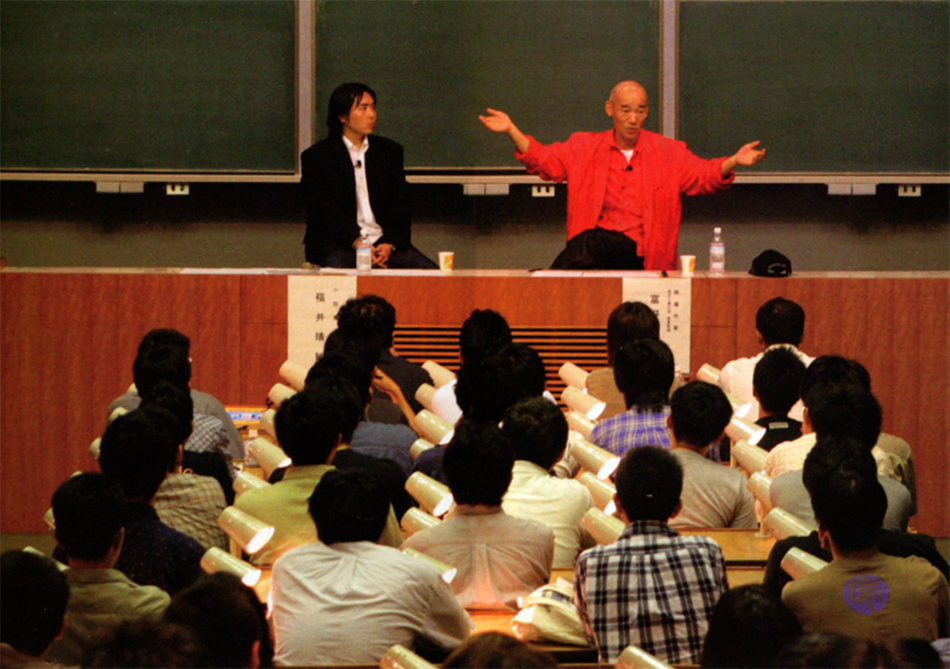
At Kanazawa Institute of Technology, director Yoshiyuki Tomino, who teaches the course “Gundam Creation Studies,” held a special public lecture featuring writer Harutoshi Fukui. Addressing students who will shape Japan’s technological future, the two passionately discussed how technological ideas confined to theory alone might lead humanity down a path of unhappiness. Here we present their engaging conversation in full.
TO EXPRESS ANYTHING, YOU FIRST NEED A BROAD GOAL
Tomino: Recently, an article in the Sankei Shinbun caught my attention. It featured a professor from Tokyo Institute of Technology, who mentioned that graduates from that esteemed engineering school overwhelmingly cited “writing skills” as what they wished they’d learned more about during university. Once out in the real world, the necessity for strong communication skills becomes painfully clear. I’m unsure if Kanazawa Institute of Technology offers a course specifically on writing, but you should all certainly be mindful of its importance. Today, we’re fortunate to have Harutoshi Fukui, a professional writer, with us. I’d like him to share his insights on writing and expression. Fukui, your writing style emphasizes concrete details to build realism. Could you start by explaining why you employ this particular method?
Fukui: Fundamentally, I’m driven by the necessity of making wildly fantastical stories feel genuinely believable. Literary and mystery circles are constantly fussing over the notion of realism, which can be tedious. But in my case, I’m driven first by the desire to create large-scale entertainment, so when I try to clear those hurdles and craft big stories, that’s the only approach that works. Rather than just throwing up my hands and saying, “it’s fiction, so anything goes,” I build up this ground-level sensibility, “this kind of thing happens, right?” “people react this way, don’t they?” and amass it until I arrive at a world of complete fabrication.
Naturally, this leads to questions about how thoroughly one should research to achieve realism. Before researching, though, you must clearly define what exactly you want to express. When drafting an outline, you’ll inevitably find gaps in your knowledge, things you don’t yet understand. You must focus your research on these areas to convincingly craft your narrative. For example, merely writing “the missile exploded” offers neither authenticity nor impact. Instead, specifying the missile’s model, its range, and precisely how the smoke curls upon launch creates a vivid, believable image. Effective writing and expression rely heavily on having a clear internal goal. Consider the agony of writing forced book reports, such tasks don’t enhance your writing skills at all. Conversely, setting an overarching personal goal makes expression much easier and fundamentally changes the kind of information you absorb.
Tomino: In other words, before even beginning to write, one needs an intuitive ability or sense to set meaningful goals?
Fukui: Exactly.
Tomino: Then what about individuals lacking that intuition or sense? How can they develop it?
Fukui: “Sense” may seem elusive, but living a normal life naturally sparks curiosity in various things. For me, it was movies. I wondered why Japanese action movies always featured explosions far inferior to Hollywood’s. It couldn’t just be budget constraints. From that frustration sprang my dream: to create entertainment that could topple Hollywood’s dominance. Ironically, I never aspired to be a novelist; movies were my goal. My talents just happened to manifest through writing. It always irritated me that Hollywood seemingly monopolized cinematic success. Yet Japan had Gundam, a uniquely captivating concept. I thought, if we could use Gundam as a stepping stone to create broad, mass-appealing entertainment, we could spark significant change. If we could translate Gundam’s social themes into entertainment that reaches everyone, perhaps we could make the world a slightly better place. That leap of imagination is what drove me.
Tomino: So you recognized something within Gundam that could be expressed differently. Perhaps this reflects shortcomings in my work, but what specifically did you envision?
Fukui: The core issue with Gundam is that its true essence is hard to convey to general audiences because it revolves around robots, an inherently absurd premise. So, when initially envisioning a Gundam-like narrative, I realized it couldn’t be set in outer space or the future. For the average person to deeply relate to such issues, to see themselves genuinely reflected, the setting had to be contemporary Japan. I imagined constructing a Gundam-like scenario domestically, a war-like situation that forced everyday people to confront questions like, “Why do we fight?” Exploring this scenario naturally revealed the peculiar condition of postwar Japan, a nation that had seemingly forgotten war altogether. Simply put, I got deeply engrossed. Plus, the rapid fluctuations in domestic and international affairs over recent years made it endlessly fascinating to explore. That’s why I’m still writing today, even though, honestly, I’m not particularly fond of military-themed fiction.
DREAMS OF SPACE TRAVEL: A PATHWAY TO GUNDAM
Tomino: When it comes to research, the internet has undeniably made collecting information effortless. However, since I started regularly using the internet, I’ve encountered a surprising difficulty: if you don’t have a clear goal in mind, the sheer volume of data scattered chaotically online actually makes research harder, not easier. Without a guiding purpose, it’s nearly impossible to navigate this vast sea of information effectively. This reality is harsh, especially for students. Think about it, how many 22 or 23-year-olds have clearly defined ideas about their future direction? Very few, I’d wager. Honestly, expecting them to have concrete ambitions at that age is unreasonable. Yet, paradoxically, to even begin finding your direction, you need some kind of broad purpose or goal to steer by.
Fukui: I think as soon as you start talking about “purpose” it tends to sound preachy. But it doesn’t have to be anything grandiose. All you really need is a simple, genuine desire, something like, “Hey, I’d like to do that someday.” Let’s take Director Tomino as an example. Honestly, he didn’t have some lofty mission or noble purpose. (laughs) His big dream was something much simpler: “I really want to travel through space.” Every kid dreams of space travel at some point, but Tomino took it to another level. Even as a middle-schooler, he was already so passionate that he delivered a full-blown lecture about space travel to the entire student body, over a thousand kids!
Tomino: Just to clarify, that was fifty years ago!
Fukui: Right, back then, landing on the moon was pure fantasy, yet he had already figured out theoretically how it might be achievable. Now, imagine if he’d just pursued that dream conventionally, joining Mitsubishi or some company and working on rocket development, honestly, that’s a pretty dull story. But fortunately, he was terrible at the math essential for rocket science. Forced to abandon that specific dream, he ended up falling into animation, a field he didn’t particularly care about initially. If he’d just grudgingly made anime while nostalgically lamenting, “I really wanted to go to space,” that wouldn’t be interesting either, and it certainly wouldn’t have landed him a teaching position at a university! What set Tomino apart was that when he found himself working in the anime industry, specifically the lowest rung of the genre ladder at the time, robot anime, instead of just punching the clock, he asked himself how he could make it genuinely enjoyable. He decided to channel his childhood dream of space travel into the stories he told. Robots fighting? Sure, why not set it in space? From there, he started earnestly exploring questions like: “How would humans live in space? What technological advancements would we need?” So, his boyhood dream of space travel became the guiding principle behind his robot anime. And from this impulse, Gundam was born.
The point here is that even a vague childhood dream like wanting to travel to space can profoundly influence your life if you keep it close to your heart, always ready to seize opportunities that bring you closer to it. Life is an endless series of choices, and if you keep your core desire clear, even just loosely, you’ll know which path to take when confronted with those choices. And that greatly increases your chances of success. Director Tomino could have chosen a different route, perhaps working on critically acclaimed dramas or literary adaptations. Professionally speaking, prestige-wise, such genres would’ve been more appealing. But he chose robot anime instead, precisely because A Dog of Flanders wouldn’t have taken him to space. That single choice shaped who Tomino is today. A sense of purpose doesn’t have to be grand, just sincere.
Tomino: He’s quite right. The problem is that when you explicitly say “set clear goals,” people immediately think they must come up with something serious and rigid. Instead, it can begin simply: “Hey, that’s weird,” or “I kind of like this.” When you’re young, particularly in middle or high school, even into your early twenties, many of the interests you adopt are heavily influenced or even imposed by trends, your peers, or societal pressures. But interests you develop purely on your own in elementary school, especially around fourth or fifth grade, often become foundational, something capable of supporting you throughout your whole life.
Fukui: Ultimately, it’s about discovering what genuinely intrigues you, what makes you say, “If it were me, I’d do it differently.” Everyone has at least one thing they’re particular about. Rather than consciously trying to hold onto that feeling, the key is simply recognizing it. People who grow up without identifying their true interests often end up focusing solely on comfort or financial gain. Yet, innovations and enterprises born purely from those motivations often lead only to stagnation and dead ends. Unfortunately, we might be veering toward that mindset nowadays. Of course, market incentives are necessary for technological advancement, but lately, it feels like we’ve lost a sense of balance.
Tomino: Even in the act of creative expression, people can get caught up in immediate gains. Once you’ve tasted success or profit, it becomes incredibly difficult to step away. But lingering there indefinitely kills creativity, nothing new emerges. Yes, major technological leaps offer great profit-making opportunities, and there’s nothing inherently wrong with that. But rather than being fixated solely on profit, we should continually ask ourselves what fundamental ideas lie at the heart of that success. Only then can we truly harness our skills and insights to create something new.
IMAGINING HOW TECHNOLOGICAL DEVELOPMENT AFFECTS HUMANITY
Fukui: Many of you will soon enter fields of technological development. When you do, it’s essential to consider not just how far you can push a technology, but also to vividly imagine how these developments might impact human physiology and society as a whole. Once you foresee potential negative consequences, it’s crucial for each developer to personally reconcile those issues with the trajectory of their work. Gundam itself illustrates this beautifully. Gundam depicts a future with enormous space colonies, artificial cities floating in space, but Director Tomino himself believes people could never realistically live in such colonies. His recent work, King Gainer, offers a more grounded vision of the future: constructing domed cities in previously uninhabitable places like Siberia, turning today’s comfortable living areas into vast agricultural regions. Relocating humanity within Earth, he argues, is far more realistic and cost-effective than building elaborate space colonies. Interestingly, this idea emerged purely from Tomino’s intuitive reaction: “I simply wouldn’t want to live in a space colony.” That simple, instinctive rejection became the seed for an entirely new vision.
Tomino: To be honest, my skepticism about space colonies only solidified itself fairly recently. For decades, immersed in the Gundam universe, I had accepted the colonies unquestioningly. It wasn’t until two years ago, when a newspaper asked me to contribute an article envisioning life in space for the 21st century, that I recognized deep within myself that the concept felt utterly false. Why? Because I’d spent 20 years simulating life within space colonies through Gundam, and when forced to approach it from a realistic standpoint, it became painfully clear how absurd the concept was. Humans aren’t machines, we instinctively draw comfort from looking up at clouds, stars, or watching sunsets sink below the horizon. Our daily emotional experiences depend profoundly on these natural sensations. Imagine trying to soothe yourself inside a confined, three-kilometer-wide cylinder, human sensibility isn’t so blunt as to adjust easily to such artificiality. Of course, theoretically, we might evolve to inhabit space one day. But developing such a future demands acute intuition, a sense of when something, though logically feasible, feels inherently wrong. To nurture that instinct, we must cultivate our physical senses and emotional sensitivity.
Fukui: Take the space colony example: when I was younger, I probably would’ve shrugged and said, “Sure, you can still shout, ‘I love you, Naoko!’ inside a colony.” Maybe you’d look up and see her rooftop floating above, adapting emotionally, even finding romance in gazing upward as though spotting the evening star. But realistically, imagining generations, babies to elderly, living their entire lives in such an environment seems brutally restrictive. A common modern misconception is that humans can readily adapt to any environment. Thanks partly to anime and manga, we casually assume we could live comfortably in space colonies. But human adaptability has limits. Despite our technological leaps in the past century, fundamentally, our bodies and minds haven’t changed much since Japan’s Meiji era. We still have essential needs that no technological advancement can erase. Today, technology development often neglects those basic human requirements, forcing us to adjust painfully rather than supporting our intrinsic well-being. For example, consider advanced mobile phones equipped with locator devices. They prevent employees from slipping away unnoticed to nap or watch a movie during working hours. Yes, slacking off isn’t ideal from a productivity perspective, but humans aren’t designed to be relentlessly productive. Such moments of reprieve are fundamental to a fulfilling life. Yet today’s technologies seem intent not on enhancing life’s richness, but on relentless optimization of productivity, a dangerously misguided approach.
Tomino: Exactly. Returning briefly to physicality, the old saying, “A sound mind dwells in a sound body,” can seem merely rhetorical, and I too once dismissed it lightly. But experiencing aging firsthand has convinced me thoroughly of its truth. Youthful bodies possess the resilience and adaptability needed to respond dynamically to life’s demands. Aging, however, gradually erodes these capabilities, making sustained wellbeing more difficult. Without basic physical vitality, maintaining emotional health becomes nearly impossible. Sharing such thoughts with you students here at Kanazawa Institute of Technology might seem irrelevant, but it’s anything but. Individuals with skewed perceptions produce equally skewed ideas, and when such individuals possess powerful technological knowledge, they risk dangerous outcomes, as extreme as the sarin attacks perpetrated by Aum Shinrikyo. Those individuals weren’t irrational; on the contrary, they carried out their attacks calmly, even convinced of their moral righteousness. Synthesizing sarin gas isn’t trivial; it’s incredibly hazardous. Yet they pursued this task persistently. It’s essential to reflect deeply on what physical and emotional conditions enable people to execute such actions.
HAD THEY LIVED ORDINARY LIVES, THEY COULDN’T HAVE RELEASED SARIN
Fukui: When Director Tomino speaks of a “sound body,” he isn’t implying that you must be physically flawless or free from disabilities. It’s about having self-awareness and the ability to manage yourself, no matter what physical challenges you may face.
Tomino: Thanks for clarifying that! (laughs)
Fukui: You mentioned Aum Shinrikyo earlier. I genuinely believe that if the cult members had engaged more fully with ordinary, everyday life, simply shopping in local stores or strolling around their neighborhoods, experiencing their lives physically, they wouldn’t have been able to commit such a horrific act. Living normally makes the fabric of society tangible, impossible to disregard. When you start considering how your actions affect real people around you, like realizing, “Sure, this might serve humanity in theory, but it’ll also kill the fishmonger I visit every day”, you simply stop. That’s what physical awareness and being grounded in daily life means. To put it bluntly, don’t become trapped in purely intellectual abstractions.
Tomino: Perhaps instead of “a sound body,” it’s more accurate to call it “a sense of everyday reality.” Actively engaging your body in everyday life is essential. Only by nurturing your physical experience of daily reality can you reach a neutral mental state from which genuine thought and new ideas emerge. Cultivating this kind of daily bodily awareness is foundational, whether you’re thinking about innovation, grappling with complex problems, or simply reflecting on your own life’s direction. In fact, maintaining a practical, physical connection with your surroundings might well be the most crucial building block for whatever path you choose in the future.
Source: Gundam Ace, January 2004