Could Tomino & Yoshikazu Team Up Again?
A Yoshiyuki Tomino × Yoshikazu Yasuhiko Reunion in the Cards?
Sunrise’s GM Declares: “Masterpieces Are Born from the Clash of Creators”
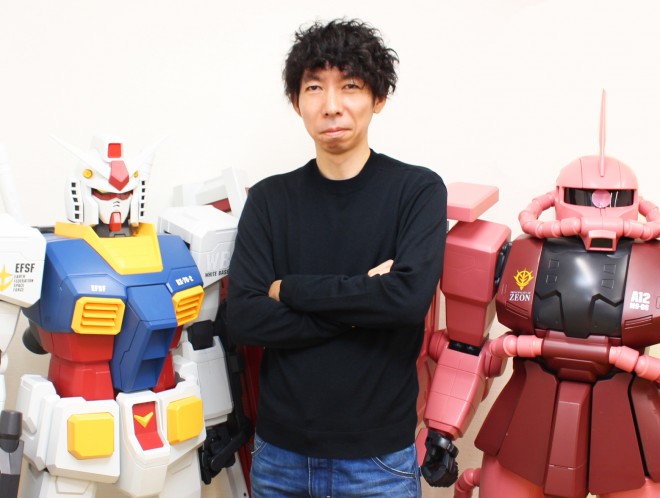
Mobile Suit Gundam, which marks its 40th anniversary this year, remains a juggernaut, an IP that Japan proudly holds up to the world, still commanding an enormous fanbase. It’s fresh in everyone’s memory that in the summer of 2018, a Hollywood live-action project was announced, sending Gundam fans across the globe into a frenzy. We sat down with Naohiro Ogata, the General Manager (hereafter GM) at Sunrise who steers the entire Gundam franchise, to ask about the anxieties surrounding “live-action adaptation,” a phrase that borders on trauma for anime fans, and the possibility of Yoshiyuki Tomino and Yoshikazu Yasuhiko teaming up once again.
AVOIDING ANOTHER “DARK HISTORY”? THE LIVE-ACTION FILM’S NON-NEGOTIABLE: JOINT DEVELOPMENT OF SCRIPT AND DESIGN
――First, tell us about your role as GM when it comes to Gundam content.
Naohiro Ogata: About two years ago, I stepped into a position overseeing everything Gundam-related, both production and sales. And “Gundam” is a single word covering an enormous range, from the existing catalog to the newest works. My job is essentially to handle Sunrise’s branding across the entirety of that “Gundam business.”
――So you have jurisdiction over every Gundam work?
Ogata: More or less, yes. Fundamentally, anything bearing the Gundam name belongs to Sunrise rights-wise, so I’m in the position of keeping an eye over all of it, end to end.
――Looking back on these two years as GM, how does the job differ from producing?
Ogata: I originally joined Sunrise because I wanted to do production, so I found real reward in the producer’s job, actually getting to build the substance of a work. But for these past two years I’ve been entrusted with the GM role, which means taking the bird’s-eye view. There’s the business side, of course, but I also have to set the compass, the guiding principles and direction for where Gundam is headed as content. Rather than focusing on a single work, I’m watching over the whole, so the nature of the job is distinctly different.
――As GM, you’re exactly the person we want to grill about the Hollywood live-action film. Are you involved in the Hollywood production yourself?
Ogata: Yes. The live-action film is a venture with a considerable budget, involving people overseas as well, so it’s not just Sunrise, the entire group is moving in lockstep on what kind of business this will be. That said, when it comes to the substance of the film itself, Sunrise is taking full responsibility for its development.
――This is exactly what we wanted to ask you about. Among Japan’s anime and manga fans, Hollywood adaptations of beloved properties, the live-action Fist of the North Star (1995), Dragonball Evolution (2009), are branded as “dark history.” You could almost call them traumatic experiences. Regarding the 1995 Hollywood Fist of the North Star, Nobuhiko Horie, who was editor-in-chief of Weekly Shonen Jump at the time, looked back on it this way: “With overseas productions, what’s hard is that just translating the script is a massive undertaking. Even if you check the script and ask, ‘Is this actually interesting?’, if they answer, ‘It is to Americans,’ there’s nothing more you can say. That’s how difficult the gulf of culture and language is.” Times have changed, of course, but experiences like these have left plenty of anime and manga fans casting a skeptical eye at “live-action adaptations.” So what were Sunrise’s reasons, and conditions, for greenlighting a Hollywood version?
Ogata: The Hollywood film is being made by Legendary Pictures, but the single biggest point of this collaboration is that the script and the design are being developed jointly.
――Meaning it won’t end up wildly divorced from the source material, the way the old Hollywood Fist of the North Star and Dragonball did?
Ogata: The absolute crux of it is this: unless both Sunrise and Legendary sign off, neither the script nor the designs get approved. So in the sense that Sunrise bears firm responsibility for development, there’s a guarantee it won’t become “something that has nothing to do with Gundam.”
――That’s a relief.
Ogata: I’m sure it’s what fans are most anxious about, and it was the part Sunrise treasured above all else, which is why, from the outset, the premise was that we’d only partner with a company we could truly create together with. Legendary is a major studio, yet in character it’s close to an independent, they made Godzilla (2014), among others, and they strike me as remarkably light on their feet, with a genuine hunger to bet on Japanese content.
――So they have the mindset of taking on new challenges, too.
Ogata: They do. They have this drive to keep generating new works, one after another. And at the same time, they’re conservative to a degree that has us at Sunrise thinking, “You’re allowed to modernize it more than that, you know,” they have their own sense of what makes Gundam Gundam, and a real respect for Japanese creators. In that sense as well, I don’t believe this will become “a movie that’s Gundam in name only.”
――Fans are surely curious about the mobile suit designs as well.
Ogata: The designs are still in development. Sunrise is at the center of that work, and fundamentally the original, foundational designs are… ah, I really shouldn’t say much about this (laughs). For now, let me put it this way: since Sunrise and Legendary are developing them together, rest assured the designs won’t land wildly off the mark either.
SUPPORTING THE WORK OF BOTH CREATORS IS SUNRISE’S WAY OF “GIVING SOMETHING BACK”
――Your work as a producer, and certainly as GM, must involve close relationships with creators. And when you say Sunrise, two names come up: director Yoshiyuki Tomino, the “father of Gundam” himself, and Yoshikazu Yasuhiko, one of Japan’s defining animators and the chief director of Mobile Suit Gundam THE ORIGIN. You must work with both of them often.
Ogata: Mobile Suit Gundam THE ORIGIN, which Yasuhiko directed, was in production somewhat in parallel with Mobile Suit Gundam UC (Unicorn), the series I produced. We were, so to speak, “in-house rivals,” so we didn’t really have many chances to talk, but lately we’ve been having all sorts of conversations.
――So even within the same company, other works are rivals to the people doing creative work. Incidentally, with THE ORIGIN, the “Chronicle of Char and Sayla,” the prologue section of the main story, has now been fully adapted to film, but there were reports that the One Year War portion, the main story proper, would not be produced. Has that been formally decided?
Ogata: It is. There’s a long and complicated history behind it, but as a project, THE ORIGIN was drawn to a close with the “Chronicle of Char and Sayla,” just before the One Year War begins.
――How does it feel to have to say “no” to living legends of Japanese animation? What are the difficulties, or the joys, of working alongside them?
Ogata: My relationship with Yasuhiko is still fairly new, we’ve really only been talking for about the past year, so I think that’s still ahead of us. But with Tomino, I’ve worked continuously since the days of Brain Powerd (1998) and Turn A Gundam (1999). Fundamentally, the foundation of the way I think about the production side owes an enormous amount to Tomino’s influence.
――Director Tomino is famous for being a force of nature.
Ogata: Tomino turned 78 this year, and yet he simply works harder than anyone, I have nothing but respect for that. He’s driven by this motivation to “keep working until the day I die,” so he’s ferociously curious about everything. The way he keeps his antennae up is unlike an ordinary person’s, and that attitude has influenced me deeply. He scolds me constantly, but honestly, having someone who will get angry at you like that is a rare thing, and every time it happens I find myself returning to my original resolve.
――Recently, Part 1 of the theatrical Gundam Reconguista in G, Tomino’s latest work, which you produced, hit the screens.
Ogata: Yes, and commercially, thanks to everyone’s support, the results were very strong. We haven’t been able to expand the number of theaters, which I apologize for, but the numbers we’re seeing are almost unthinkable for a release of that size. There are five parts in all, so as the series rolls out, we’d like to grow the theater count as well.
――You mentioned earlier that you’ve been in ongoing contact with Yasuhiko for about a year now. Is that collaboration for the sake of a new work?
Ogata: I can’t say anything about that yet either, but Yasuhiko, just like Tomino, is a man who will keep working until he dies, and I believe that for Sunrise to support that properly is our way of repaying our debt to both of them. If there’s something either of them wants to express, Sunrise intends to back them to the fullest. Though of course, when the answer has to be no, I’ll say no (laughs wryly).
THE TOMINO-YASUHIKO RELATIONSHIP MIRRORS TAKAHATA-MIYAZAKI:
THEY NEED EACH OTHER
――As GM, how do you perceive the difference between the two directors’ stances?
Ogata: Tomino is a director in the theatrical sense. Yasuhiko is an author… no, an artist. They’re completely different. Yasuhiko, I think, is a man who can do everything himself. THE ORIGIN manga is truly magnificent. Of course, it rests on the foundation of Tomino’s original First Gundam, but that entire work was born from Yasuhiko’s own hands, and Tomino, conversely, cannot do that. Tomino is a director; when it comes to making animation, he can’t carry it all the way to the finish line by himself. Studio Ghibli’s Hayao Miyazaki is someone who, if he chose to, could draw the whole thing on his own, so if anything, in my mind Yasuhiko gets categorized as the Miyazaki type. That difference is significant: Tomino creates by borrowing many hands, drawing stimulation from the people around him, whereas Yasuhiko is the type who takes what he’s been thinking, what he wants to convey, and reproduces it on screen directly with his own hands.
――I see. In terms of how they work with staff, Yasuhiko’s question is how to faithfully reproduce the image in his head. Tomino, on the other hand, actively brings in young talent, as a director, he always seems to be seeking out fresh stimulation.
Ogata: That’s right. I think part of why Tomino recruits young people and keeps studying is to extend the lifespan of his own “creativity.” Right now there’s an exhibition touring the country called The World of Yoshiyuki Tomino, and if you go, you can see all of it, which creators he worked with, and what kind of stimulation he drew from each of them as he built his career. And this is absolutely not me playing favorites for my own company: I believe anyone involved in making things absolutely must see that exhibition at least once.
――You said earlier that Yasuhiko is close in type to Miyazaki, and by that logic, it strikes me that Tomino is the late Isao Takahata’s type. When I interviewed Tomino before, he spoke of the influence of “Takahata-ism,” saying, “I worked under Takahata’s ‘influence,'” and he stated plainly, “To me as well, Paku-san was my ‘master.'” The parallels hold: Takahata and Tomino are animation directors who don’t draw; Miyazaki and Yasuhiko are supreme animators. Could Tomino and Yasuhiko ever team up again?
Ogata: I would love to see it, but I do not want to be the producer in charge (laughs). In truth, there’s no question that “each of them needs the other.” But, and this is my own personal theory, there’s a part of the director and the key animator or designer that fundamentally can never intersect.
――Miyazaki and Takahata never worked together again after Castle in the Sky, and since the first Gundam, Yasuhiko’s only involvement in Tomino’s works has been character design.
Ogata: On a creative production floor, works are born out of clashing, and the more the clashes, the more interesting the work tends to become. It’s genuinely unfortunate, but projects that proceed on a basis of “let’s all get along nicely and peacefully” usually turn out boring. Of course, there are works forged in furious, knock-down-drag-out arguments that still don’t sell. But in my experience, the anime that sold always had conflict behind them (laugh wryly). It’s a strange thing to say, but even if you trace this universe back to its origin, it was born from clashes at the molecular level. In the end, you simply can’t make anything without that, a lesson I’ve learned by grinding my heart down, over and over, every single time.
WHAT SUNRISE NEEDS: A “STRONG-ARM PRODUCER” IN THE MOLD OF TOSHIO SUZUKI
――If that’s the case, then the producer’s role, wrangling all those clashes into a finished work, looks enormous.
Ogata: Absolutely. What I want is for a producer to step forward and say, “I want to make something with those two.” From where I stand now, I’d give them the green light: “Go for it.”
――So depending on the producer, it could actually happen.
Ogata: That’s right. Sunrise, fundamentally, runs on its producers. What matters most is what kind of work a producer wants to make, and with whom.
――And you yourself don’t feel like taking on those two?
Ogata: I want to see a Tomino–Yasuhiko team-up, but right now I can’t bring myself to say “I want to do it.” I could work with either of them individually, but I don’t currently have the time or the energy it would take to handle both at once. That’s the dilemma of the GM position, I can’t pour all of my resources into the production floor.
――Meaning that to control the clashes between those two as their producer, you couldn’t do it while wearing both hats, GM and producer.
Ogata: If those two ever did decide to work together, I believe the producer would have to throw their entire life onto the fire to take it on. Nothing less could stand up to the two of them.
――Director Tomino, who regularly speaks about the importance of staff work, has said of the relationship between Miyazaki and producer Toshio Suzuki: “Miyazaki won the Oscar because he teamed up with Suzuki.” And there’s the famous episode where Takahata turned down Miyazaki’s request to produce the film Nausicaä of the Valley of the Wind, until Suzuki reprimanded him, and Takahata finally agreed.
Ogata: Relationships are crucial. If someone were to take on a work by those two, then Tomino and Yasuhiko would be spending precious time on it, time of which they have only so many years left. The producer and the production team would have to face that with total sincerity, and pay a price worthy of claiming that much of those two men’s time. And that’s not just a matter of money, the goal has to be making the work a genuine hit and getting it in front of everyone. I see it as a job that demands exactly that, so I hope a producer emerges who’s steeled enough to go that far. That said, even supposing they did reunite, there’s no telling how it would turn out. For all we know, the universe itself might be destroyed (laughs).
Source: Oricon News (published December 26, 2019)