
G GUNDAM TIMELINE
THE WAY OF THE CONQUEROR
G GUNDAM WORLDVIEW

NEAR FUTURE
In the 2050s, humanity faced an unprecedented crisis. This was the prelude to a slow demise. Even with the planet unifying into economic mechanisms consisting of several regional blocs, there was no means to counter the depletion of Earth’s resources and the population explosion.
Although an Earth Restoration Project had been implemented many times over, the planet was battered and bruised from a burgeoning population and was no longer a safe haven for humanity to live on for the long-term future.
However, the scientific civilization not only polluted the Earth but also gave humanity a glimmer of hope. The fusion of molecular-level engineering techniques and genetic-level bioengineering led to the rapid development of a new ultra-engineering.
Yet, the new level of scientific civilization, led by gravity control, lacked versatility. The ultra-engineering, which remains shrouded in secrecy to this day, had the nature of not functioning unless it consumed the remaining Earth’s resources.
To explain using an example from modern science, it might be best to compare it to a superconducting coil. While the energy required to maintain it is minimal, imagine a system that requires thousands of times more energy to start up. To sustain a population of a hundred people, energy equivalent to the disappearance of several major cities must be used.
A scientific civilization that cannot help all of humanity but guarantees the survival of a portion of humans. The pros and cons of this cannot be discussed here. The fact was that the time remaining for humanity was running out.
The total population of the Earth had exceeded 10 billion, and the deterioration of the Earth’s environment had reached a point where it could not be stopped. Only people from major countries could live out their natural lifespan, and even their average life expectancy was getting shorter every year, which was impossible to stop despite advancements in medical technology.
To give humanity a future, there was no choice but to abandon many of their own. This conclusion had to be kept strictly confidential. The governing bodies of each country deceived their citizens and embarked on space development projects. “To protect the polluted Earth, we must develop space as a new frontier.” By partially unveiling gravity control technology and offering a glimpse of the possibility of space migration, it was natural for the people of each country to become enthusiastic about space migration.
By feeding back this technology to large-scale work robots, colony construction could also be rapidly advanced.
JUST BEFORE THE FUTURE CENTURY
Space colony construction was progressing in order, starting with the superpowers. Each country was desperate. A delay in construction meant missing the bus to the future, and it was obvious that no subsequent buses would ever come. Even if they had the technology, countries with unstable political situations could not participate. It was clear that with the resources left on Earth, only a limited number of colonies could be completed. Countries that could not maintain the secrecy of this information could not even begin colony construction as a national project. Countries that were able to manage information to the extent of giving their people the delusion that colonies would be built one after another were all pouring in all the power they had and rushing to construct colonies.
F.C.1
It seems unlikely that there will be room for mutual aid between economic blocs. Secretly, each nation’s top officials are selecting who gets to migrate. As colonies of the superpowers complete their preparations for launching into space one after another, conflicts over migration rights erupt globally. Those who cannot migrate, those opposed to it, repeatedly commit acts of indiscriminate terrorism, resulting in numerous casualties.
In response to terrorism, each nation decides to repurpose mobile suits, originally designed for labor, for military use, focusing on preventing chaos as departure looms. Consequently, military mobile suits see a significant and rapid improvement in performance. Then, the day arrives—an unexpected event for much of humanity. All the remaining energy on Earth is exhausted, and nation after nation begins to launch their space colonies.
Power shortages lead to deaths worldwide, and Earth enters a period of darkness.
After overcoming the initial chaos, space colonies float in the expanse of space. Many people with emigration qualifications escaped from Earth, and up to sixty percent of the population relocates to the colonies. Those left on Earth are primarily the lower-income classes and naturalists.
Thus ends the terrestrial age, and a new chapter in human history, the Future Century, begins.
F.C.2
The governance of the space colonies falls to those from each country, leaving the Earth without its best leaders. This leads to regional conflicts across the globe. Even the space colonies, products of advanced science, still need resources from Earth. Predicting a global war and indiscriminate use of thermal weapons that could threaten their existence, the space colonies form a coalition and send a peacekeeping force to Earth. The strength of this force, primarily mobile suits, drives rapid development in their armament and mobility. Yet, facing guerrilla tactics by the Earth forces across vast terrains, the peacekeepers struggle, and efforts to quell the conflicts fail. Earth faces the threat of a full-scale war using thermonuclear weapons.
F.C.3
The colony coalition resolves to engage in full combat, forming large mobile suit forces. Meanwhile, Earth’s conflicting parties also unify and organize. The conflict between the colony coalition and the Earth shifts. The coalition launches a massive drop operation with their mobile suit forces, devastating the Earth forces and averting a total war. This conflict later becomes known as the First Chaos War.
F.C.4
A ceasefire is established under the leadership of the colony coalition. Each colony begins to individually govern Earth nations. As peace is restored, the united purpose of the colony coalition dissolves. This leads to an arms race among the colonies. The war prompts each nation to start developing next-generation mobile suits, using Earth as a massive testing ground.
F.C.5
Distrust permeates among the nations and their respective sectors, many of which were once Earth territories. It was nearly miraculous that the space colonies had ascended simultaneously. Falling behind even slightly could threaten a nation’s survival, casting a shadow of impending full-scale war once again. If a Second Chaos War were to erupt, it would inevitably lead to human extinction, with no victors remaining.
Despite the impossibility of halting the arms race, the intellectual class begins to consider how to avert a final war given the irreversible change from the old Earth system.
Meanwhile, development of the ultimate mobile suit with exceptionally responsive controls, the Mobile Trace System, progresses.
F.C.6
Small-scale conflicts erupt over the mining of Gundarium alloy on the moon’s surface.
(Note: The Gundarium alloy in the FC world is different from the one in the UC world. To organize the story, before the One Year War in the UC world, the Earth Federation Forces changed the orbit of an asteroid containing a large amount of meteorite iron and fortified it. It was called Luna II, and among the extracted ores, a metal superior to titanium alloy was found. The Earth Federation Forces called the alloy made from that metal Luna Titanium and adopted it for the top-secret weapon RX-78. Later, Zeon-affiliated engineers also adopted the alloy, and because it was used for Gundam, it came to be called Gundarium alloy. In other words, in the UC world, “Gundarium alloy was used for the Gundam,” while in this FC world, “the units made of Gundarium alloy are called Gundam.”)
Each colonial nation entered a state of war readiness over the mining of Gundarium alloy, which would dramatically improve the performance of mobile suits.
The Mobile Trace System was completed. Dr. Deuder, a military researcher and advocate for avoiding war, proposes the “Gundam Fight” concept. This idea isn’t new—avoiding war on home territories by having a third-party adjudicator determine outcomes in a no-man’s land. However, concerns remain about the fairness and regulation of the weaponry brought in. Dr. Deuder’s version of the Gundam Fight, however, is comprehensible to all: in a public setting, nations use fundamentally similar ultimate Gundams to battle and determine the outcome. Unsurprisingly, each nation expresses basic approval for the Gundam Fight, merely waiting for detailed adjustments. This averts the crisis of a total war.
(Despite differing national interests, gaining such unanimous consent was a near-impossible feat. Though unofficial, it’s reasonable to assume that past Shuffle Alliances played some part in this, conducting necessary maneuvers behind the scenes.)
With Dr. Deuder at the helm, the Gundam Fight International Preparation Committee is formed.
F.C.7
The Mobile Trace System and prototype Gundarium alloy were distributed to each colonial nation. Naturally, major powers possess superior Gundarium and higher tech levels, so not everything is equal. However, each nation is able to develop at least one Gundam, and the preparation committee is elevated to an official governing body, named the Gundam Fight International Committee. The Gundam Fight International Treaty is established, and mobile fighters, all bearing the name ‘Gundam,’ are rolled out by the colonies.
Thus, each nation’s mobile fighter, crafted from precious Gundarium alloy, is honored with the name ‘Gundam.’
F.C.8
The first Gundam Fight is held on Earth. Neo Greece is decided as the winner of the first tournament. Each colonial nation is placed under Neo Greece’s leadership. Under Neo Greece’s leadership, each colony maintains its autonomy without jeopardizing its sovereignty.
In the years that follow, the Gundam Fight continues to be held every four years. (Though it’s difficult to confirm, it’s likely that some form of deterrent played a role behind the scenes. That the first champion, Neo Greece, could rule genteelly for four years demonstrated the true spirit of the Gundam Fight. If there’s a precedent, other nations are less likely to engage in underhanded tactics. The manipulation of public opinion likely involved shadowy figures whose identities are clear.)
F.C.48
Neo England’s Gentle Chapman achieves a three-peat victory in the tournament. Inspired by Chapman’s performance, leaders of various national colonies analyze the strength of his John Bull Gundam, calculating enhancements for their own Gundams’ rifle weaponry.
F.C.52
The balance maintained by the Gundam Fight among the nations begins to falter with Neo England’s third consecutive victory. The development of beam weapons becomes a catalyst, heightening suspicions of an arms race among the nations. As a result, for the first time, the Gundam Fight is postponed.
F.C.56
The International Gundam Fight Committee successfully adjusts the interests of various nations. The twelfth Gundam Fight is held, with Master Asia of Neo Hong Kong winning. The victory of his melee-focused Kowloon Gundam proves that world domination cannot be determined by the superiority of beam weapons alone. Thus, rather than wasting resources on an arms race, the urgent task becomes developing strong Gundams.
The nations of the colonies pause their beam weapon development and shift focus to developing mobile suits optimized for melee combat.
Master Asia’s victory prompts a reconsideration of the original principles of the Gundam Fight.
The world order is covertly monitored by the Shuffle Alliance’s leader, the King of Hearts—none other than Master Asia himself. His accomplishments are credited with averting war.
F.C.60
The thirteenth Gundam Fight is held. The new story begins as Domon Kasshu of Neo Japan descends to Earth.
Gundam Fight, Ready, Go!
FUTURE CENTURY TIMELINE
PATH TO THE GUNDAM FIGHT
Note: This timeline represents the views of the Animec editorial department. We believe that an official timeline will be released from the appropriate sources in the near future, but we hope that this will serve as a useful reference material until then.
■ Before FC
2015 AD
On the cusp of the 50th anniversary of the Apollo moon landing, the U.S. President makes a bold declaration: humanity will set foot on Mars.
2030 AD
A joint space station, the fruit of collaboration between Japan, the U.S., Europe, and Russia, is completed. Research into hybrid materials begins in earnest.
2040 AD
Humanity reaches Mars, and space development reaches its zenith. However, chronic financial shortages put grand plans for space colonies on indefinite hold. Amidst hybrid materials research, a serendipitous discovery lays the groundwork for the fundamental theory of gravity control.
2070 AD
Earth’s population surpasses the staggering milestone of 7 billion. Environmental destruction accelerates at a breakneck pace.
The energy theory for gravity control is perfected. Basic experiments commence.
2080 AD
Foundational data on gravity control is compiled. In response, the upper echelons of nations worldwide set in motion a top-secret plan for exodus from Earth.
Around this time, a strange phenomenon emerges on Earth: average lifespan decreases, yet birth rates soar.
As a result, people’s sense of crisis reaches a fever pitch.
The United Nations exists in name only, having effectively collapsed. Ethnic conflicts erupt in nation after nation.
Information about space migration is partially released, a calculated move to manipulate the public psyche.
2085 AD
Ethnic conflicts intensify. Some nations, like China, are forced to change their systems.
Others, like Russia and Siberia, resort to secession and independence.
2090 AD
Earth’s population crosses the 10 billion threshold. In every nation, momentum builds for seeking new frontiers in space.
Gravity control mechanisms are perfected. Construction of space colonies begins in earnest.
The development of mobile suits (MS), humanoid multipurpose robots for construction work, is a resounding success. Colony construction proceeds at a blistering pace.
Earth’s environment deteriorates further. Strange diseases emerge, particularly among infants and young children. At this point, while population growth rate plateaus, the situation continues to worsen steadily.
■ Future Century
F.C.1
Space colonies are completed, starting with the superpowers. Selection of emigrants begins, centering on high-ranking government officials.
Terrorism runs rampant across the Earth as people vie for the right to emigrate, resulting in numerous casualties.
Each nation decides to repurpose mobile suits for counter-terrorism, leading to a dramatic increase in performance.
Using all the energy currently available on Earth, the space colonies begin to rise. Many people on the ground die due to power shortages.
60% of the total population moves to the colonies, while the remaining 40%, consisting of low-income earners and naturalists, stay on Earth.
F.C.2
Conflicts erupt in various parts of the Earth in the absence of the ruling class, showing signs of a world war.
The colonial nations establish a national federation and dispatch a joint security force to the Earth.
Around this time, the performance of mobile suits in each colonial nation improves dramatically.
The joint security force fails to quell the conflicts, facing the risk of an all-out war due to thermonuclear warfare.
F.C.3
The colony federation organizes a large-scale mobile suit unit. In response, the conflicting parties on Earth also unite.
The nature of the conflict begins to shift towards the Earth versus the colony federation.
The colonial federation forces, centered on the mobile suit unit, launch a massive descent operation on Earth. The Earth’s forces are devastated (First Chaos War).
F.C.4
A ceasefire is established between the Earth’s forces and the colony federation. Individual rule by each nation is restored.
The colony federation collapses with the establishment of the ceasefire. Each colonial nation rushes into an arms race to secure dominance.
Each colonial nation begins research on next-generation MS, with Earth becoming a testing ground for this purpose.
F.C.5
The momentum for an all-out war rises again (Second Chaos War).
Intellectuals begin to consider ways to avoid war.
Research on the Mobile Trace System begins.
F.C.6
A small-scale clash occurs on the moon over the mining of Gundarium alloy raw materials. Each colonial nation enters a state of war readiness.
The Mobile Trace System is completed. In response, military researcher Dr. Duder announces the “Gundam Fight” concept and begins coordinating with each colonial nation.
Each colonial nation announces its acceptance of the Gundam Fight concept. The risk of all-out war is averted (although unofficial, the lobbying activities of the Shuffle Alliance are confirmed).
The Gundam Fight International Preparatory Committee is established, centered around Dr. Duder.
F.C.7
Each colonial nation begins developing Mobile Fighter (MF) units for the Gundam Fight.
The preparatory committee is upgraded to an official hosting organization.
It is named the “Gundam Fight International Committee,” and the Gundam Fight International Treaty is established.
Each colonial nation rolls out MF units one after another.
F.C.8
The first Gundam Fight is held on Earth.
Neo Greece is decided as the winner of the first tournament. Each colonial nation is placed under Neo Greece’s leadership.
Henceforth, the Gundam Fight is to be held every four years.
F.C.48
Gentle Chapman of Neo England achieves the feat of winning the tournament three times in a row.
Impressed by Chapman’s performance, the leadership of each colonial nation permits the strengthening of rifle-type armaments.
F.C.52
Suspicion rises among nations due to the arms race. As a result, the Gundam Fight is postponed for the first time.
F.C.56
The International Gundam Fight Committee succeeds in coordinating the interests of each nation. The 12th Gundam Fight is held.
Master Asia of Neo Hong Kong wins. Attention is focused on the close combat-oriented Kowloon Gundam.
Each colonial nation changes the development route of Gundam Fight units. The origins of the Gundam Fight are re-examined.
F.C.60
The 13th Gundam Fight is held.

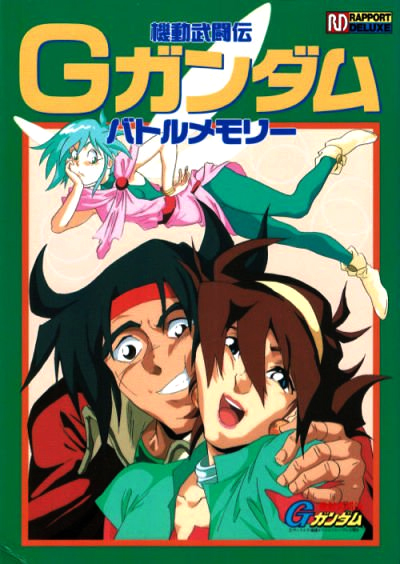
PUBLICATION INFORMATION
Publisher: Rapport
Published: 1995.05.01
Price: 1,300 yen
Size: B4