A NEW TRANSLATION: WHAT & WHY
WHAT EXACTLY IS “A NEW TRANSLATION,” AND WHY CALL IT THAT?
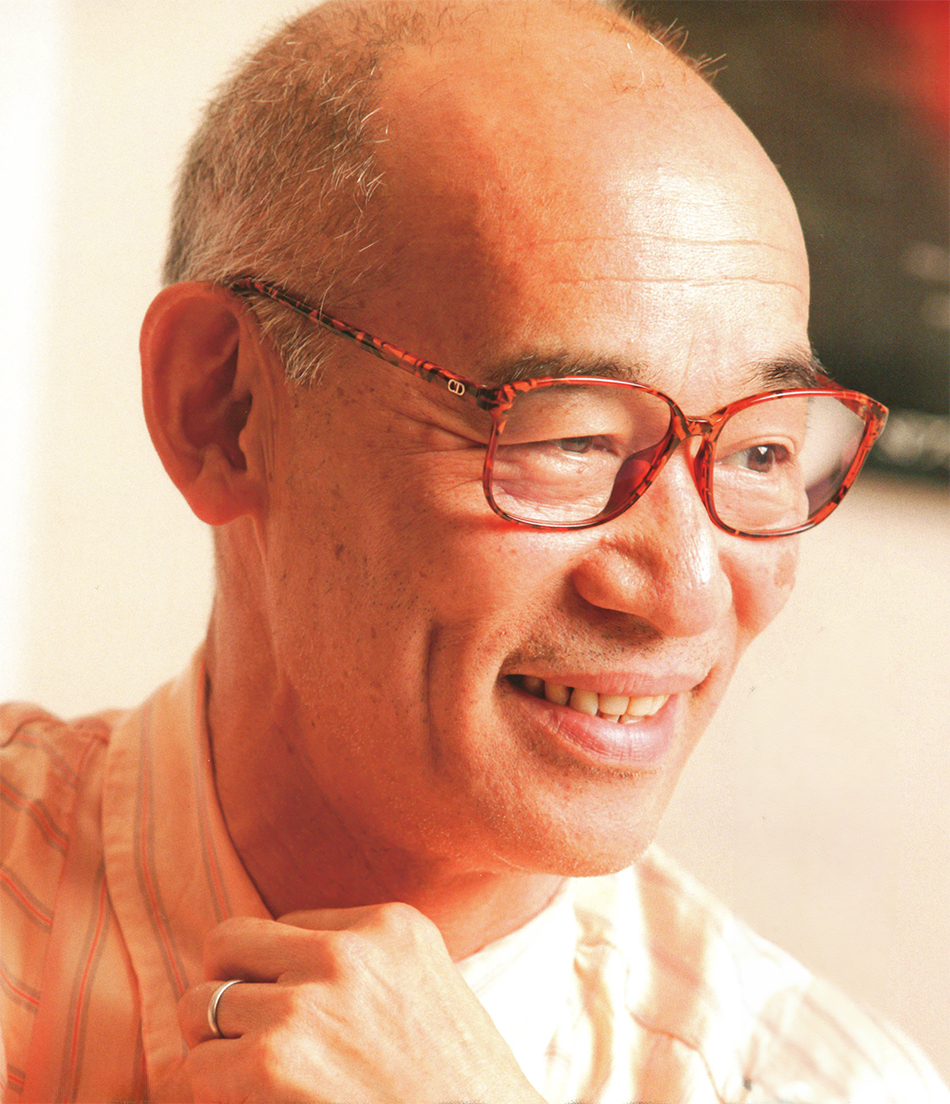
For this magazine’s first in-depth conversation about the theatrical version of Zeta, we asked General Director Tomino to speak candidly. With the premiere just around the corner, what’s moving through his mind now? And what meaning did he pack into the phrase “A New Translation?”
Photography by Chisato Hikita (HYTIDE)
Interview and Text by Tomohiro Kawakami (Brain Navi)
HOW, AND WHY, ZETA WAS REVIVED TWO DECADES LATER
――What are the circumstances and the significance behind reviving Zeta twenty years on?
Initially, it was entirely Bandai Visual’s idea (laughs). From a business perspective, it’s undeniable that various commercial considerations kickstarted this project. But personally, I felt it might be possible at this point to rework and reconstruct the original series. Accepting this assignment based on that hunch, what I can say now is that it turned out to be a far more intriguing piece of work than I expected.
――What, specifically, did you find intriguing about this assignment?
Simply creating a digest version of the TV series would have held little interest for me. Honestly, I had a deeply negative impression of the original TV version. I wondered whether it was possible to alter that negative image. When I found the method to do so, the job evolved beyond mere summarization. Transforming the story from Kamille’s bleak ending, his spiral into rage and despair, to one where he does not break down… perhaps depicting him as a boy who does not lose control became necessary. This was the method I devised to shed the negativity surrounding the original. From my standpoint as a creator, successfully executing this revision felt profoundly fulfilling, arguably more engaging than producing something entirely new.
THE MESSAGE BEHIND THE TV VERSION OF ZETA AND KAMILLE’S CHARACTER
――Had Kamille’s temperament been on your mind back when you were producing the TV series?
I wasn’t hung up on it during production. If anything, it started bothering me after we finished. During production I deliberately seeded a subtext, “If all you do is watch anime, it’ll make you stupid.” TV anime is, in a sense, a commercial for toy companies. If anyone was going to make a robot show around that theme, it was going to be me, that was my resolve. And in the sense that I pushed it through to the end, I had a very strong “serves you right!!” feeling toward the stakeholders. From the sponsors’ point of view, of course, that’s outrageous. I’m sure there was indignation and backlash along the lines of, “We’re the ones putting up the money, what the hell do you think you’re doing?” I say “I’m sure” because none of it reached my ears directly. Sunrise’s management shielded me from all of it back then. It might look reckless, but this wasn’t some jab at the sponsors; to me it carried tremendous meaning.
I genuinely wanted to embed the message, “Getting too immersed in anime isn’t healthy. In fact, the more devotedly you watch a work like Gundam, the more you need to watch yourself.” When you consider the responsibility that comes with releasing a work to audiences, I hated the notion of putting out something that irresponsibly just sells toys. I said there might have been howls of resentment from the sponsor side, but maybe what I feared wasn’t actually there. Maybe that’s why I never heard it. At this point, there’s no way to verify it. And in a sense I saw myself somewhat prophetically, warning the audience, “Keep this up, and you’ll end up like Kamille.”
Even so, the way it ended left me with nothing but a bad feeling once it was over. That was what I hated most. In the process of making it, I was fully intentional about it. I was convinced that, if anyone could do something like that within a robot show, it would be me. At the time, people also put it another way: “Tomino’s an idiot for doing robot shows.” A whole camp formed around, “We’re never going anywhere near robot shows.” I very much wanted to show even that crowd, “You can do this kind of thing with them, too.” But while that deliberate stance was fine as a stance, I also felt very strongly that, as a work presented to audiences, it wasn’t good for it to be so forcefully message-driven. To tell the truth, ever since finishing the TV run I had convinced myself that I’d made and included an episode dealing with Kamille after his mind collapses. Then, toward the end of the year before last, when we got the theatrical project moving and I rewatched the final episode, I realized it wasn’t there (laughs). It just ends after laying down foreshadowing, doesn’t it? I couldn’t help slumping in disappointment.
――So this re-structuring is also meant to see that intention through?
That’s right. Twenty years have passed, anime is this widely recognized, and the reality of Japan now is one where you can feel the psychological pressure weighing on young people. It’s as if everyone’s turned into Kamille. Feeling that’s dangerous, and thinking about the medium’s role, I wanted to re-structure Zeta as entertainment. The project circles back to that most fundamental point. Anime or not, these are films, and films are, at base, entertainment. With a robot show, all the more so, it may be especially suited to being entertainment. So I thought strip off all the heavy seriousness and make it a robot show that prioritizes enjoyment.
At first glance that might seem terribly trivial, but for me, when I think about anime as entertainment, the things that are fun to watch are, after all, what qualify as entertainment. So I wasn’t going to shape it into the kind of work that, like Kamille as he used to be, might even provoke an autistic-like withdrawal. If, on TV, that direction only ever got as far as laying foreshadowing, then by flipping it just a little, maybe, just maybe, it could surprisingly turn into entertainment. That hunch proved dead-on, and that’s why I threw myself into the job. When you see the new film, I think Kamille will come across as brighter; that’s not some accident. We rebuilt it with that intent.
REORGANIZING THE TV VERSION FOOTAGE AROUND A CINEMATIC CORE
――In terms of the TV episodes, were there scenes you wanted to include but had no choice but to leave out?
There’s something genuinely fascinating about the work of structuring a narrative. With the production of the first film, once we had the structure locked down, the omitted scenes didn’t even cross my mind. The real challenge is that as creators, we can almost never bring ourselves all the way to actually “cutting” a scene. We stay emotionally attached to each one. But when you finally wrap it as a package, when you’re satisfied with the construction of the drama, you can scarcely remember what you removed. Of course, if you go back later you can say, “Oh, this was cut here, and that was trimmed there,” but even from the scenes I cut, the crucial bits, the things I wanted to communicate, are embedded all over the film. That was what I felt most keenly this time, the pleasure of building a drama. It made me think, maybe I’ve finally become a proper filmmaker (laughs).
――Watching the film version, it really feels cohesive as a single movie, and the build-up toward the final scene struck me as very cinematic.
That’s because the method of filmmaking is fundamentally different. Most sequences up until the later portions closely follow the original TV series. However, due to our distinct approach, the overall composition appears entirely new. Each shot has been meticulously crafted to reinforce a cinematic experience, but at its core lies a strong narrative throughline. This overarching narrative flow infuses each detail with deeper significance.
ACTING THEORY IN THE FILMS AND HOW KAMILLE’S TEMPERAMENT SHIFTS
――Returning to Kamille, as you mentioned earlier, is creating a version of him who doesn’t ultimately break down central to this narrative core?
You might not fully grasp it without seeing all three parts, but my basic stance is to change the angle of view just a little. We make that perfectly clear in Part 1. In one of the new sequences, there’s a moment where Kamille leans on Reccoa, really drapes himself on her. In the TV version, Kamille never did that. That’s the difference. I’m going to keep saying the same thing across Parts 2 and 3 as well. There’s a person like Reccoa; there’s a self who can think, “It’s okay to lean on her,” and there’s also the self who, when Reccoa passes by and asks, “What’s wrong?” just keeps quiet. Whether, when she says, “What’s wrong, Kamille?” you can honestly answer, “I’m tired,” that’s the decisive difference. Keeping quiet is easier. From Reccoa’s point of view, she’s got some other person, an annoying presence, leaning on her.
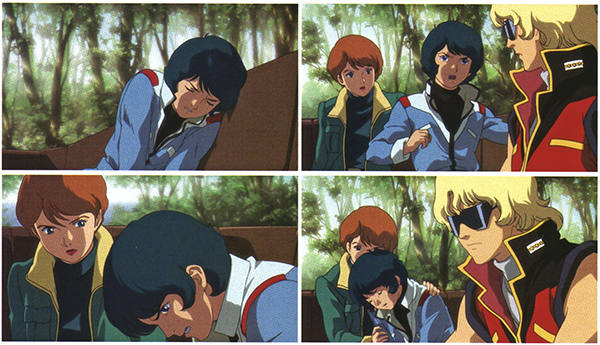
If Reccoa, feeling bothered, gives the leaning Kamille a little pop and flicks him off, his pride gets bruised, right? Even so, if he can still keep leaning, it becomes, “Huh, there are breasts here… this might feel nice,” you know? (laughs) That sense of “this might feel good,” that action of “it’s okay to lean,” because we don’t do that, our communication with others doesn’t go well. Whether you’re a man or a woman, in the end, the difference between snapping and not snapping comes down to that. You should try that approach to another person at least once; it’s the initial motion of building a relationship. This time, that new scene is the first time Kamille can make contact with someone else, so I rewatched the TV version up through around episode twenty and decided, “It has to be here.” If he leaned on Emma at this point, people might think Kamille’s a pervert, that he’s angling for her. I actually considered having him lean on Char. But if I did that within the structure of Part 1, I’d lose the chance to explain another piece of Zeta’s background. So, instead, Char puts a reassuring hand on Kamille’s back. This careful consideration of character interaction is what I mean by acting theory.
――Does the idea of comfortably leaning on someone reflect a change in your own mindset over the past twenty years?
Not at all. Let me put this very crudely and talk about the approach to performance. How you conceive the construction of the drama is, in truth, nothing but logic work. If you get that wrong, you can’t build the surge of feeling toward the grand finale, the dramatic through-line; in other words, dramaturgy, the craft and technique of dramatic construction, the methods of playwriting. That’s all there is to it. Framed as acting theory, like we were just discussing, it might sound intuitive, but it’s not decided by intuition. With extreme rigor, we’re expressing, in that form, how far to let Kamille step forward. It’s very exacting. I care about how the body tilts, down to the angle. The angle of each body as they touch, even the angle at which contact occurs, comes into play. It’s something today’s anime creators surprisingly overlook, but sex scenes and contemporary acting theory are closely linked. Because with sex, you have a face-to-face composition; then you slide outward; then you even go back-to-back.
In a sex scene there are angles for that. Applied to the Kamille-and-Reccoa moment in Zeta, once we had the overall plan for the trilogy’s grand finale, we set Kamille’s final destination. The result of that is the performance in that scene. If you set the acting and the angles without first mapping the finale, you’ll get it wrong. If you do it by feel, you’ll get it wrong. Because the finale was visible this time, every bit of the acting there could be expressed as calculated. The crucial thing is, “Don’t show the calculation.”
KAMILLE’S BRIGHTER TURN AND THAT CURIOUS RELATIONSHIP WITH FOUR?
――You mentioned Kamille’s character portrayal has shifted slightly; how will this affect his relationship with Four Murasame, expected to appear in the second film?
The TV version Kamille started off on the wrong foot. Because we adjusted his initial interactions this time around, we were able to incorporate his scenes with Four in the second film almost unchanged. If anything, it’s the TV Kamille’s reactions that are odd. As the creator, I was fully aware of it. Basically, I carried a distaste for having built that scene as a compromise for television. That ties directly to Kamille’s first moves toward other people. Thanks to having him lean on Reccoa, his kiss with Four can be depicted authentically and without issue. This isn’t some surprise; it’s exactly as planned. Which is why I’m confident the narrative flow from the first to the second film feels extraordinarily natural.
This refined structure allows Kamille’s interactions with Sarah and Katz in the latter half of the second film to appear genuinely objective. In the TV run, there were places where we forced relationships just to keep things going for a year. With Sarah and Katz, Kamille is in an objective position; if he’s able to look at people this coolly, then he never needed to snap in the first place. This correction seamlessly connects through the second and third films without any strain. As for how this affects the ending, audiences will have to see the third film to find out. But the conclusion feels very natural. And I think that makes for very good entertainment. Something quite ordinary… I’m about to let the most embarrassing line slip out of my mouth… a youthful romance movie (laughs bashfully). It’s not edgy anime in the least. Which is very troubling for me, I must say (laughs).
WHAT IT MEANS TO INTERWEAVE RECUT FOOTAGE WITH NEWLY ANIMATED CUTS
――You’ve rebuilt the film by adding new shots into a re-structured cut of the TV material. Did you have any reservations about using footage from twenty years ago?
Actually, the companies involved have been considerate enough not to mention this explicitly in magazines and such, but it’s precisely what I wish they’d address. There’s a striking disparity between the 20-year-old animation and the newly produced scenes. You can’t definitively say which is superior, but having both coexist makes for an incredibly jarring viewing experience. So it’s not a film you can blithely praise. In Lorelei, Koji Yakusho’s face looks the same in every shot, doesn’t it? (laughs) But here, Kamille’s face looks different from cut to cut. Even so, I undertook this convinced that we might still be able to make a film that’s fully watchable. That said, I don’t think it’s at a level you can just grin and bear. For some people it may be intolerably bad. The cause likely lies in how I worked on the TV version, I gave the animators too much free rein in my direction. I’m sorry for that. To make up for it, on this theatrical version we’ve put real effort into bringing the new cuts closer to the look of the original style.
――There is certainly a sense of incongruity, but I also came away thinking of it as a kind of rebirth. That may be because I know the TV version, though. I do feel uneasy, wondering how it will play for people seeing Z for the first time now.
You’re absolutely correct. Where the old and new film intermix, first-time viewers this go-round will probably think, “What an oddly hard-to-watch anime.” I wouldn’t dare complain about anyone feeling that way. After all, if there’s an animator whose drawings haven’t changed in twenty years, it’s maybe only someone like Yoshikazu Yasuhiko. Even Hayao Miyazaki, though perhaps he hasn’t changed that much, likely wouldn’t want his older work juxtaposed directly with his new material. We certainly could’ve replicated the original animation style for all new scenes, but frankly, I had no interest in forcing such a task on animators. One reason is that demanding such fidelity would leave us without anyone willing to do the work.
Another reason is quite simple. I genuinely couldn’t determine which version of Kamille from the TV series we should emulate (laughs). I thought it over again and again. But in the TV run, Kamille was drawn by many different hands. There are dozens of Chars and dozens of Kamilles. And if someone comes along and says, “The Kamille I’ve drawn now is the real Kamille, so stop complaining,” well, then that’s the end of the conversation (laughs).
REWRITING EVERY LINE FOR THE SAKE OF “A NEW TRANSLATION”
――Even in scenes that were in the TV version, there are places where the phrasing of the dialogue has changed. Was that something you altered in the flow of the edit, or did you change it because you didn’t like the original lines? Which was it?
There isn’t the slightest room for, “I changed it because I didn’t like the line.” It’s all for the dramatic structure. I’m using everything as a mechanism to make the dramatic construction hold. Say there’s a three-second line. Even that mere three seconds gets changed into a line that’s necessary to build the drama that follows. The same goes for the single spirited cries a character lets out in the middle of a battle. Actors are strange creatures; depending on the flow of the story and the recording session, the way they put out that battle cry changes, so once you re-edit, you inevitably have to change every line. Conversely, if you can’t change it, it’s more often the dramatic composition that collapses. Naturally, there are lines from the TV version I was quite fond of, and there are spots in the film version where those remain. But that’s coincidence.
They only remain as a result of the process; I never think, “I love this line, so I refuse to cut it.” When a favorite line survives, it’s because within the flow we built, the same thing still works, and that’s delightful! That’s how it feels. You lay things out as this is the only shot that will work; this is the only footage that will work. You line up the necessary cuts, sometimes remove them, sometimes shift them elsewhere. As you proceed with that work, taking a sequence that had fifty cuts and, in the end, rearranging it down to around twenty, you’re also thinking, as you’re laying them out, what each line in each spot ought to be. Even when you’ve winnowed the cuts and reached the stage where the cut count is fixed, you still ask, “Is this really right?” You check the revised lines yet again, down to whether, on the ADR script, the line will read as a spoken line. For that reason, most of the dialogue gets changed three or four times, sometimes four or five. You could say, almost all of it.
――So it truly feels less like a remake and more like a new translation.
In fact, it’s far more complicated than making something entirely new, as we must rely on existing footage, including scenes we’d rather avoid using. You start thinking about how to compensate with other shots. When we designate a new cut, we stamp “NEW” on the edge of the storyboard, but that’s the easy part. The problem is that once you start saying “this is new” and “that is new,” what happens? It leads to the conclusion that we might as well draw the boards from scratch. But if you slice entirely new boards from the outset and build everything out of new cuts, a different problem arises. The theory of dramatic construction I mentioned earlier, that only works because the original drawings exist. If everything were new, the work would be much easier, I’m sure. But if everything were new, you’d no longer be doing a re-composition from fifty cuts down to twenty; it would no longer be that kind of restructuring, and the flavor of the original Zeta would be entirely different. People would absolutely say, “The visuals are beautiful, but this isn’t Zeta.” It would end with reactions like, “In the end, some old fart just did whatever he wanted,” and that’s that.
Broadly speaking, the reason almost all so-called remakes can’t beat the original is that, while they claim to preserve the “essence,” they’re actually completely new works, made to the creator’s whims. The essence of the original resides only in the original work itself. Which is why, in the end, there are many cases where, even if the film is rough, even if it’s monochrome in standard format, you have to watch it that way. “The new one has clean visuals and actors I like, but somehow the original is better.” That’s as far as it goes. The moment you make everything new, there’s no “remake” left at all.
We wrestled many times with whether to make every cut new. But the reason we ultimately had to keep the old material is that this piece is a digest and a remake, and above all, Zeta Gundam only exists as that TV version, that thing. Even if we made a New Zeta Gundam, people would inevitably say, “The ‘new’ one sure moved well, it was pretty, but, well…” So yes, there’s a gap between the old animation and the new, but because of that, we could build this composition. If we’d made everything new, we’d never have adopted such a painstaking compositional approach (laughs). I did feel the frustration of not being able to erase the incongruity, but this is why I didn’t force the animators to do copy work, “Make it look like the old animation.” I came to feel, when the first film was finished, that the significance of this Zeta project lies in showing it with the twenty-year gap included.
“The Z Gundam film trilogy is fun. You can see twenty years of TV anime history all at once! The animations clash, but it’s still fun.” It’s become a work you can view from two angles, from the production side and from the side of dramatic composition. On top of that, we nudged the characterization of our protagonist, Kamille, just a little. If you want to feel just a bit more upbeat, then change the way you look at things, the way you take things in, just a little. I think we’ve built a work that embodies that concept over the span of twenty years. I believe, in five years or so, such a viewpoint will define how this Zeta Gundam trilogy is critically received.
A TV ZETA THAT FORESAW TWENTY YEARS OF CHANGE
――You mentioned everything was structured logically, but have societal changes over the past 20 years, particularly views on warfare, historical backdrop, the tenor of the times, find its way into the narrative composition?
Not in the least. In this round of work, what surprised me most was my own TV version. That surprise had two main currents. The first was the web of relationships in the ensemble. Simply sorting through and presenting that many interlocking relationships turns out to be compelling in itself. It was interesting to discover there were enough human connections to use, without much efort, the “Grand Hotel” form (the script format established by the film Grand Hotel: large cast of characters, the allure of an all-star ensemble). For example, Reccoa, on whom Kamille initially leans, eventually betrays him by siding with the enemy. Relationships involving characters like Scirocco and Sarah, introduced in the second film, seamlessly fit into the Grand Hotel format. In other words, a story in which many people enter and exit. Not a single character’s position needed additions or corrections. For Kamille, they constitute the reality surrounding him; the construction that leaves that reality untouched and shifts only his point of view a little, that was possible from the outset. I was floored to realize TV Zeta possessed such a fundamentally cinematic structure. As for the second and third films, there were times the sheer mass of material made me want to throw in the towel. The work was truly hard. But looking back now, it was a tremendously rewarding job.
The other surprise was the perception of war. After 9/11 (the September 11, 2001 terrorist attacks in the United States), acts of terror came to be fully recognized as part of warfare. Zeta Gundam had already adopted a style of war that, when it aired, wasn’t generally understood. To put it bluntly, it anticipated it. That within the military there could exist an anti-military faction; that such a faction could mount a coup, even topple a state; and that a form of war with no precedent, war without a formal declaration, warfare akin to terrorism, would emerge: Zeta properly prefigures all of that. Further, and this is an unhappy development, because Gundam is a work built around having a boy as its protagonist, the “child soldier” exists; we’ve reached the point where audiences can look at that existence without an extreme sense of incongruity.
Additionally, though fully apparent only in the second and third films, characters like Scirocco and Haman represent observers of warfare, introducing third and fourth parties and complicating traditional narratives of conflict as purely binary. Earlier anime typically depicted war as a simple struggle between good and evil, but this series realistically captures the multifaceted nature of warfare.
Because this work’s narrative and war structures contained a foresight into today’s world, revisiting and revising this story at my current age felt neither childish nor trivial. Instead, it seemed like a prophetic exploration of present realities and future considerations. Especially, and this won’t hit home until all three films are complete, while I won’t go so far as to call it a “message,” in the sense of depicting the relationship between war and people, I think we managed to display a structure that’s easier to understand than trying to depict realistic war. Even as an old man past sixty, I can confidently say that this was deeply engaging.
In that sense, I’d like even teenagers who think they dislike robot shows or war stories to give it a try at least once. You might feel a realism akin to looking at the world as it is. It might not be mere make-believe. For me, despite the fact that I made it, I’m honestly delighted to have encountered a work about which I can say these things, and even more delighted that I myself once did it. Moreover, being able to present such a work to audiences was no bad thing for me, and I’m confident it won’t be a waste for those who watch it.While it’s purely an entertainment work in the anime medium, I mean for it to carry the question, “So… what do we make of this?”
――It’s true that the events following 9/11 have likely made this story more accessible.
Initially, I resisted elements of the narrative, feeling they were forced merely to serve the story. This resistance dissolved not merely because of my skillful narrative structuring but because society undeniably transformed over the last two decades. Standing here in the early twenty-first century, I’m made to feel keenly that we’ve entered a time when we really do have to think about war. Which is why I sincerely hope people won’t approach it with the prejudice of “it’s just a robot show with a war for a backdrop.”
REFLECTING ON NEWTYPE THEORY TWENTY-FIVE YEARS AFTER GUNDAM
――Does your theory of Newtypes still resonate in Zeta?
In terms of how the term “Newtype” has been used within Gundam, it hasn’t evolved, in fact, it might have regressed. I’ve come to believe the ultimate form of Newtypes doesn’t necessarily involve evolutionary progression. Rather, Newtypes ideally should form a collective consciousness rooted deeply in human common sense. And where that Newtype theory ultimately leads, I believe, is to a height where one can pour into one’s own sensibility a Japanese aesthetic exemplified by wabi-sabi. Put this in print now and I imagine people will say, “I don’t understand a word of it.” Making it intelligible, finding a way to communicate it, is something I mean to keep as a life’s theme until I die.
If there’s one thing I can say about why this relates to Newtypes right now, it’s this: if, through wabi-sabi, you could truly bring your own sensibility and your daily life into practice, war would be impossible. At its core, the fundamental aim of Newtypes is absolute peace. Achieving perpetual peace, where warfare becomes obsolete, demands an extraordinarily refined sense of aesthetics, this pinnacle of aesthetics is precisely wabi-sabi.
I recently learned there’s a comparable way of thinking within Islam. Islam rejects idolatry; by rendering things in mosaic patterns, I’ve begun to feel there’s something of wabi-sabi in that, perhaps. I read a certain paper not long ago and thought, “Oh, I see.” It argued that Islam, which should have been living by a wabi-sabi-like sensibility, is now agitated, bordering on hysteria. Muslims, deeply committed to Islamic absolutism, never previously considered themselves behind the times. Yet the intrusion of the internet, mobile technology, and satellite imagery has exposed a startling reality of their relative backwardness. Two or three decades ago it would have been unthinkable, but people in the Islamic world simply didn’t believe they were lagging. The irritation and humiliation at that gap, the paper said, has become the primary motivation for today’s Islamist terror actions. Well, this is only one theory, but I think there’s a side of it that’s true.
To dissolve that irritation, there’s nothing for it but to understand wabi-sabi. If you can invest your own sensibility and your own way of life in wabi-sabi, war disappears. Such irritation can’t be resolved through religion alone, methods like those attempted by groups such as Aum Shinrikyo will never suffice. To gain the mental state, the disposition, needed to understand and practice wabi-sabi, everyone has to face today’s very real sense of crisis. And we must carry a tension, a vigilance, shot through with apocalyptic anxiety, with the thought that humanity might at any time slide into its own end. Without that tension, you can’t reach the dimension called wabi-sabi.
First, we need the ability to recognize the hardness of present reality: energy crises, food crises, environmental pollution, every negative factor, accurately, as a negative factor. Once you have that, then collectively embracing restraint to ensure humanity’s enduring survival, embodies the ultimate expression of wabi-sabi. This, today, constitutes my theory of Newtypes.
――Could Zeta serve as an introduction to these philosophical ideas?
No chance. It’s a common robot show (laughs). However, as a creator, my sincere hope is that viewers remember these ideas come from someone deeply convinced of this philosophical framework. Though the goal is exceptionally lofty, I doubt I personally possess the skill to fully realize it. I leave that task to future generations. Precisely because I entrust it to them, I want people to recognize, even within what appears as just a mainstream robot story, that these ambitions genuinely exist.
TOMINO ON THE FUTURE OF GUNDAM AND HIS AMBITIONS
――Do you have plans to create new Gundam series in the future?
I believe that’s now the domain of younger creators. With SEED and DESTINY establishing themselves clearly within the series’ lineage, there’s no need for me to create a new Gundam. Even before SEED took shape, I’d already come to think there wouldn’t be a “new” Gundam for me. The foremost reason is that being allowed to make Turn A Gundam left me with the feeling I’d completed my grand reckoning with Gundam.
That might be personal delusion, but I genuinely feel that I’ve achieved closure with this kind of work. So I have no interest whatsoever in a new Gundam. That said, as a continuing series with an ongoing market, I want Gundam to become the work of younger people. What matters more now is the question of how people roughly two generations younger than me will make this kind of show from here on out, whether they can add new messages. That’s a brutally hard job. Which is precisely why I feel it would be odd for an old man to be the one doing it.
――Then what about an ambition to take on a TV anime series in some other form?
If I start harboring ambitions at my age, the young will hate me, so I think it’s best to say “yes, yes” and do the things the young tell me to do. I’m sorry, that sounds quite insincere, doesn’t it? (laughs) Officially, please let’s go with that. But honestly, that’s only half untrue. Ideally, young creators should present new production opportunities and project proposals. However, if I do accept such projects, naturally, my own judgment will come into play, so I won’t be making it entirely at someone else’s beck and call.
That said, whatever the work, those currently central to the business should define its direction and goals. If I tried imposing my older perspective, I’d probably get it wrong. To put it clearly, place representatives on the business frontline, and the rest of us follow their lead. If those leaders crash spectacularly, then we older folks can step into the aftermath and help expand the business field. That, I think, is the proper role for veterans like myself.
(At Sunrise Studio 7)
Source: Gundam Ace No.035 (July 2005)