HISTORIC TALK: YASUHIKO x TOMINO
A HISTORIC TALK
FROM THE PAST TO THE FUTURE
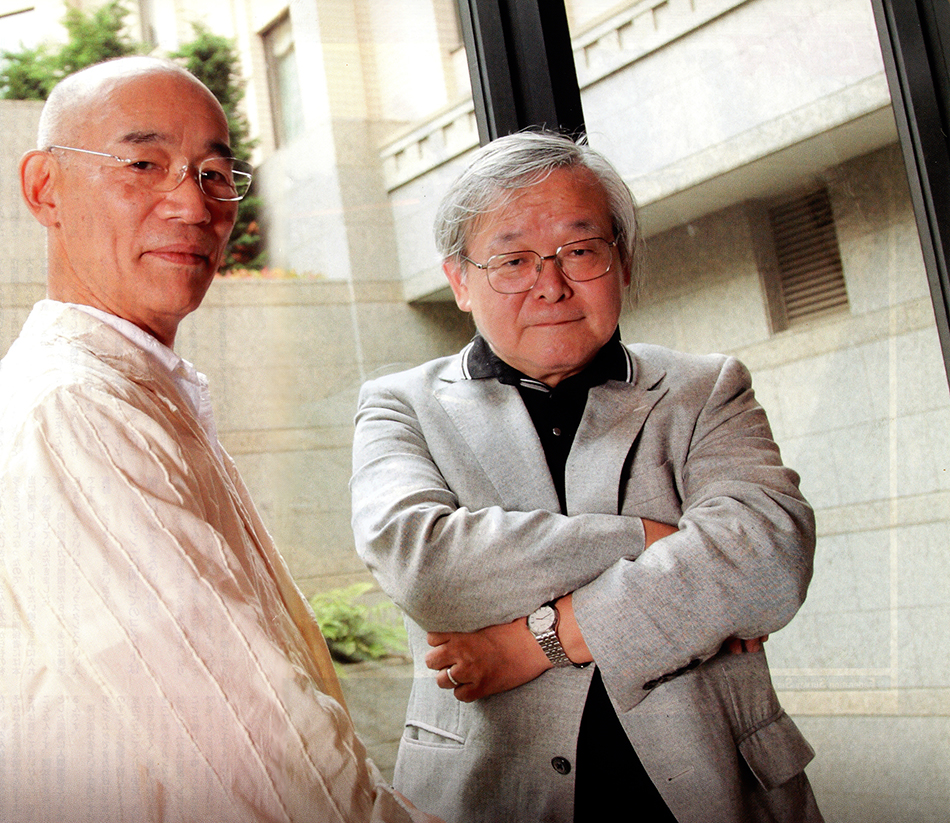
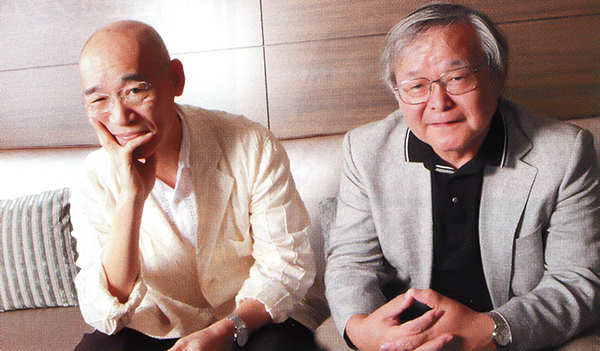
Yoshikazu Yasuhiko & Yoshiyuki Tomino
A DREAM CONVERSATION, FINALLY REALIZED!
With excitement steadily rising in Tokyo’s Odaiba district for the public unveiling of the life-sized 18-meter Gundam statue, an extraordinary dialogue took place on June 30, 2009, at a hotel near Shiokaze Park, where the towering figure stands. Having just viewed the enormous Gundam, their conversation naturally began with impressions of the experience. Here is their three hour dialogue presented in full.
SEEING THE LIFE-SIZED 18m GUNDAM
AT SHIOKAZE PARK, ODAIBA
Yasuhiko: The 1:1 Gundam is truly incredible. Honestly, I went in thinking it’d be just like an oversized plastic model, so I caught myself leaning forward in amazement (laughs). Earlier, they were checking the special effects with mist and music; will they perform that multiple times each day?
Tomino: They’ll run it every hour. Originally, they planned it only for the evening closing, but I insisted that even during the daytime it would be worthwhile if we added music and sound effects. Honestly, I joined the project midway, so we’ve had plenty of headaches and difficulties. For example, I thought we’d be able to fine-tune the mist nozzles even after setup, but apparently not. Still, if I’d known about this project from the start, I probably would have vetoed the whole idea. Thankfully, it was greenlit without my knowing, and now we’ve ended up with something fantastic. It’s a reminder of how dangerous it is for decisions to rest solely on one person’s opinion (laughs).
Yasuhiko: Yes, indeed. It’s a perfect example of “all’s well that ends well.” I didn’t expect the thoughtful production touches, so it really impressed me.
Tomino: Honestly, I didn’t even know the head could move like that until about a month and a half ago. As a director, seeing the head move immediately made me think, “Why stop there? Why didn’t they figure out how to move the hands?” And I’m still annoyed by certain details, like how poorly positioned the LEDs are in its eyes. But anyway, the important thing is, it’s completed. However, they can’t just jump right into building a Zaku without seriously reflecting on this project. If they decide to build a Zaku five years from now, it better at least stand on its own two feet.
Yasuhiko: So, in the end, you are telling them to build it (laughs).
Tomino: For example, even to represent the Zaku’s mono-eye, there are technical questions we now know we have to tackle because we tried making a full-scale Gundam. You don’t understand these things until you try. To give another example, once they had assembled the Gundam, I kept insisting they place a life-sized mannequin wearing either a spacesuit or worker’s gear on its shoulder. Otherwise, how can people truly appreciate its scale?
Yasuhiko: So, did you end up placing one?
Tomino: No. My wife and daughter came to visit, and when I mentioned it, they strongly objected. I argued that a reference point would help people grasp the Gundam’s size, but my wife said, “When people look up at that Gundam, they might dream about climbing into the cockpit themselves. But if they saw a fake mannequin nearby, the Gundam itself would immediately feel fake. Absolutely don’t put it there.” Her reasoning was that adding more artificiality would ruin the immersive effect.
Yasuhiko: Your wife’s absolutely right. So, if she hadn’t stopped you, you would have gone ahead with the mannequin?
Tomino: Absolutely. Because for the past 30 years, I’ve been constantly reminding animators to put humans next to robots for scale. From an animator’s perspective, it makes sense. But a full-scale Gundam isn’t animation or a model kit.
Yasuhiko: Exactly. The moment you add a mannequin, it immediately turns into just another limited diorama. If you really want people to sense its true size and height, you’d have to include something like a crane lift inside the setup to elevate visitors up top.
Tomino: Precisely. I did bring that up as well, but they begged me to reconsider. The second you let people on board, it triggers an entirely new set of safety and legal regulations, not to mention additional staff concerns. So, they begged me not to go there (laughs).
Yasuhiko: Plus, if you actually did it, imagine the massive queues forming in the summer heat.
Tomino: Exactly. It would end up just like Disneyland. Given that it’s meant to be free and accessible to the public, the modest performance they demonstrated earlier is perfect. The sheer absurdity of an enormous Gundam just standing there actually offers countless perspectives for reflection. I’m truly grateful to everyone involved for providing such an incredible learning experience.
Yasuhiko: Human imagination is boundless, after all. Ultimately, it’s enough to say, “Here it is, now go ahead and enjoy it however you like.”
Tomino: I couldn’t agree more.
I CAN’T COMMENT ON THE ORIGIN AT ALL (Tomino)
Yasuhiko: It was right around this time nine years ago when I approached you to ask if it would be alright for me to create The Origin. I still vividly remember you saying, “Well, let me read it,” and that’s how it all began. I planned to have another meeting once I finished, to ask your thoughts. I was sure if I talked to you mid-way, I’d lose my confidence. But given this year is the 30th anniversary, and THE ORIGIN is nearly finished, I figured whatever you’d say now wouldn’t shake me too badly. So that’s why we’ve arranged today’s talk. But I have to ask, have you read it?
Tomino: I simply can’t comment on it. Just like you mentioned, it’s still ongoing. If I say anything, it might affect the work, so I’m keeping my lips sealed.
Yasuhiko: But would you comment after it’s completed?
Tomino: Honestly, even then, probably not. It’s been built up over nine years. It wouldn’t be fair for me to say anything. I’ve explained half of my reasoning earlier during our talk about the life-sized Gundam. These projects aren’t the product of a single individual’s will. You only understand them clearly in hindsight, what worked, what didn’t, but it’s not my place to judge. It’s fundamentally someone else’s work. If I try to get involved, it inevitably leads to interpersonal friction. Even though I’m credited as the original creator, I’ve consistently emphasized that Gundam didn’t come into existence by my efforts alone. It wasn’t just the names like yours or Okawara who helped me; it was everything happening around us at the time that allowed Gundam to be born. Honestly, I used to resent deeply that Gundam debuted on Nagoya TV, a local station. Yet, looking back, if it had aired first on a major network like TV Asahi or Fuji TV, Gundam wouldn’t have become what it is now. Gundam isn’t mine alone. The “Tomino’s Gundam” label became widespread only because society accepted it. I’ve never once believed I single-handedly created Gundam. With you, Yasuhiko, a key figure from the original staff, reinterpreting it through manga form, I absolutely won’t comment further beyond what I’ve just explained.
Yasuhiko: Then let’s set THE ORIGIN aside and indulge in some nostalgia. There’s something I’ve been curious about. In Ryusuke Hikawa’s book, “From Behind the Scenes of Gundam,” there’s your original proposal. I remembered it being quite extensive, but apparently, it was only around thirty pages, spanning August to October. I’d always assumed you knocked it out overnight, but seeing this, I realize I was mistaken.
Tomino: Yes, but honestly, I don’t remember much about that at all. That’s because I’ve spent about 20 years deliberately trying to forget Gundam. After finishing Gundam, my immediate thought was: If I could create something like this, maybe I’d truly become a professional. So, I felt compelled to move immediately to the next project. From the moment Z Gundam was assigned to me, I despised Gundam. Receiving only Gundam-related work afterward was humiliating, it felt as though I was being labeled incompetent by the industry. How could I love Gundam under those circumstances? I only came to terms with Gundam in the last seven or eight years, thanks largely to the enduring fans of the original series, fans now in their thirties. Could I tell these devoted fans that Gundam had made my life miserable? Of course not. So I forced myself to rediscover a love for it, which is precisely why I could eventually embrace something like the life-sized Gundam.
Yasuhiko: When you mention those twenty years spent trying to forget, I realize it was the same for me. Exactly twenty years. But then came the 20th anniversary when media outlets started contacting me. I reluctantly looked at the magazines sent to me, and suddenly something stirred inside. During those years, I probably avoided Gundam even more thoroughly than you, who wrestled with projects like Z and Turn A. The 20th anniversary made me reconsider Gundam again.
Tomino: In my case, from Z Gundam onward, I had to repeatedly step back into the mess I’d hoped to abandon. As an adult, I had no choice but to professionally manage my aversion to Gundam because it was how I made a living. Those twenty years felt like wallowing in constant frustration and bitterness. Despite my efforts to forget, I was constantly forced to remember. But, it’s business, you do what you must to survive.
Yasuhiko: Have you ever been this candid in interviews before, talking openly about working through resentment and bitterness?
Tomino: No, I’ve consciously avoided it because being honest about that would’ve made life difficult.
Yasuhiko: People often group me with Okawara and yourself as a trio, but it’s not a flat grouping; it’s triangular, with you at the apex. You were always at the top, which allowed me to step away. If I’d stayed, I would’ve ended up exactly like you, trapped only working on Gundam projects. That’s why I left. But being at the top meant you couldn’t.
Tomino: It wasn’t that I was at the top. The industry perception might’ve been “only Tomino can do Gundam,” but from my viewpoint, Gundam was my only viable source of income. It had nothing to do with preference, I simply had no other options. Honestly, I envied you greatly. The same goes for Okawara. Being able to do other projects felt unfair. But both of you had talent allowing you that freedom. I lacked such talent, and therefore was stuck. It was painfully humiliating.
Yasuhiko: Well, I felt similarly humiliated in my own way. Precisely because I wasn’t at the top, I was free to escape and try other anime projects for the next decade, but nothing substantial came of it. Ultimately, I realized my limits as an animator, and that’s why I switched to manga. Perhaps that’s also “unfair,” as you say, because I had the freedom to do that.
Tomino: It does feel unfair. Still, most people don’t get to freely choose their careers. Around the 20th anniversary, I began appreciating the value of being known for something, even if it’s just Gundam. That helped me find some measure of acceptance for “Tomino’s Gundam.” Yet, the torture didn’t end there. Even though people recognize me as synonymous with Gundam, the new series rarely involve me. Watching younger creators continuously produce new Gundam works was maddening enough to make me want to plant a metaphorical time bomb under them. But accepting this as the natural order is something I’ve trained myself to do for the past decade.
TURN A BROKE FREE FROM THE CURSE OF FIRST GUNDAM (Yas)
Yasuhiko: With Z Gundam, I always thought you deliberately tried not to recreate the original Gundam. If you’d wanted, I believe you could’ve made it more like the original.
Tomino: No, that’s not the case. Even though the first series never got a definitive “The End,” by the time we made the films, it felt like we’d given the original Gundam a proper conclusion in terms of style. What purpose would it serve to replicate that in a new series that wasn’t meant as a direct continuation? Professionals should intentionally create something different. Throughout Z, my attitude toward everyone involved was, “You’re fools for only wanting Gundam. You’ve recklessly asked me to do this; I’ll make the protagonist go insane.” Despite this warning, they pressed ahead anyway, those adults felt no responsibility toward the work. So, I decided to do exactly what I wanted.
Yasuhiko: Including the bit where you lifted the hero’s name from Camille Claudel?
Tomino: All of it was intentional. And even after I made Z that way, the same stupid adults came back saying, “Let’s do another one next year.” Honestly, I was aghast. All right then, let’s make ZZ. But I’ll show you: this is the kind of foolish thing you’ll get. Only then did they finally catch on, “Oh, Tomino’s calling us idiots.” It took them two full years to get that. Two years of time and money. There are a lot of adults like that.
Yasuhiko: Wasn’t it after Z ended that things became publicly contentious? The previously supportive fan magazines like OUT and Animec turned critical. I only found out much later and was shocked. Why push things so far?
Tomino: I wasn’t “pushing” anything. Reality simply works that way. No matter what kind of anime it is, I refuse to lie to the children watching. It caused me no pain to depict adults as utterly pathetic, that’s reality. It’s precisely why working on Z and ZZ for two years didn’t drive me insane.

Yasuhiko: Working on The Origin made me rediscover a few things. One was how profoundly mature the original Gundam actually was. The adults were foolish, sloppy, dishonest, but there was a genuine warmth toward their humanity. But in Z, that warmth vanished. Adults became bitterly portrayed as the enemy.
Tomino: Given everything I’ve just explained, it’s only natural that warmth disappeared.
Yasuhiko: Which is to say, it’s no longer First.
Tomino: Exactly. With Z and ZZ, there was zero need to inherit First. First is complete.
Yasuhiko: Still, you did lay down tracks. Look at Space Battleship Yamato, it ended definitively, yet was resurrected because of popularity. In contrast, you structured Gundam’s ending to allow either yourself or others to continue the franchise, leaving clear avenues to move forward. You even thoughtfully provided a final scene that hinted at a broader future.
Tomino: Yet that applied strictly within the framework of the original series. Z, ZZ, and the later series aren’t true continuations of the original. They may look like they’re running on preset tracks, but narratively, the original is self-contained. Consequently, the first Gundam became an insurmountable wall. Subsequent works could mimic the style, but as a narrative, the first series remains complete. Anything created afterward was inevitably inferior, I learned that the hard way from experience. Genuine works of art are fundamentally isolated entities. Expecting to produce direct sequels to such standalone works is misguided.
Yasuhiko: Back then, you used to say you’d already shown your hand. That anyone could make one now, “go on then.” I always felt you’d put out a kind of branching track for others to enter.
Tomino: When I say “branching track,” I mean this: I showed my hand so you wouldn’t have to crawl back to “robot shows,” so the field could broaden. And in fact I reaped that benefit with Turn A. The moment I truly made peace with Gundam was with Turn A. Then I threw myself a challenge: could I embrace all the Gundams other people had made and still spin a fresh story? Only because the craft had been pried open that far could I do it. Hitting my late fifties, if I could make something that way, I could forgive myself. As “Tomino’s Gundam,” I could even draw the curtain with some satisfaction, that was Turn A. The problem is, Turn A wasn’t a hit. So I was never given chances like this to talk about it. If your work doesn’t hit, you don’t get to stand around explaining it.
Yasuhiko: Naturally, I never watched Turn A. Its wild designs and premise, excavating various mobile suits from the moon, were too much for me. Later, when scheduled for a talk with Harutoshi Fukui, I read his novelization of Turn A and found it brilliant. Fukui truly made Gundam compelling. I then checked Turn A’s materials from my son and realized Fukui was actually faithful to your original work. Ironically, the original content Fukui created fell short for me. That’s when I finally saw Turn A as a masterpiece. Your explanation now confirms my realization, it truly broke free from the first Gundam’s curse.
Tomino: Exactly. And interestingly, seeing this life-sized Gundam has again freed me. With this newfound freedom, I’m ready to create another work, whether “Gundam-esque” or not. The people behind the life-sized Gundam might never grasp its deeper significance as I have, but I’ve absorbed it fully. I’m now ready to craft a clear, anime-inspired Gundam story. Whether I’m granted another series is uncertain, but I feel equipped to show the industry that a veteran like myself shouldn’t be underestimated. I’m determined not to look backward, doing so would put me beneath the fans themselves. Gundam fans today thankfully range from their 40s onward, prompting me to think about what Gundam must communicate. I’d like to tell industry professionals to transcend mere entertainment or superficial fanservice. These statements, however, must come from the work itself, not discussions like this. It’s a tough responsibility, but anime and manga have matured to that point.
Yasuhiko:Still, with lifelong fans behind you, you inevitably have to discuss the past occasionally, like today, when I asked you. You’ve made sharp remarks about Z and ZZ, works beloved by fans now in their 40s who’ve supported Gundam all along. Your comments seemed risky. Should we make them off the record?
Tomino: Such remarks come because people only consider comic and anime fans. There’s a broader fanbase beyond the anime and manga community who grew up with Gundam but moved on as adults. They understand what I’m saying, they accept my honesty. It’s time to abandon qualifiers like “it’s just anime or manga.” Prime Minister Aso says he’ll build an “Anime Hall of Fame,” and the opposition is jumping on it to try to torpedo the plan. People should grasp what that means: the standing of anime and comics has obviously shifted from what it used to be. Even if some still sneer “it’s only anime, only manga,” it’s become a political football. Whatever the contempt, anime and comics are that kind of medium now. And yet we keep making stories that can hide behind the excuse “well, it’s anime,” and think that’ll fly? It won’t.
Yasuhiko: Before this “Hall of Fame” talk, Machiko Satonaka and Takao Yaguchi, through Manga Japan, were pushing hard for a national manga archive. I led the opposition, and they’ve held it against me ever since. So this “Anime Hall” idea also strikes me as a real problem. You just said we need to understand it, but—
Tomino: When I said “understand,” I didn’t mean “support establishing something like that.” I’m talking about the current reality, that manga and anime circulate in the halls of the Diet. I’m dead set against any “Anime Hall.” But that’s not the point. The point is that anime and manga aren’t media anymore for people who only ever look at just that. If we dawdle, they’ll climb all the way to the level of general education. In that light, shouldn’t we be throwing in content that can properly respond to that focus? That’s what I’m saying.
Yasuhiko: For me, the ’90s were a decade where I could do work I was more or less satisfied with. As a working pro, I feel like I got onto the page exactly what you just said, that even an “anime guy” thinks this deeply about the medium. In other words, what you’re calling for now, I did that in the ’90s.
Tomino: What matters is doing it now. Because now we’re in a moment where the Diet brings up anime and comics, and that’s precisely why we have to tell them: don’t you dare read only Inuyasha and then stand up in parliament to talk about manga and anime. If we don’t bottle that level of content, we’ll keep getting prime ministers at Aso’s level in rotation. We have to build a field where a comics magazine can say, “Yes, we run pieces at this level.” I’ll say it again: we live in a time when the words “anime” and “comics” get spoken on the Diet floor. We have to mature accordingly. Creators need to change their mindset, this isn’t the manga magazine world of 30 or 40 years ago anymore.

MY OWN IDEOLOGY HAS ABSOLUTELY NO PLACE IN GUNDAM (Tomino)
Yasuhiko: I’ve always felt Gundam carries enormous social and historical weight. Take the influence it had on Aum (Shinrikyo), for example. A moment ago you said we should graduate from thinking only in terms of manga and anime fandom, but graduation or not, Gundam’s reach went beyond those circles a long time ago. It spun off second-order effects. Haruki Murakami’s 1Q84 is, at its base, about Aum. For that generation, the foundation isn’t Marxism, it’s Aum. And behind that, I don’t know how strong the influence is, but Gundam is there. It clearly surpassed its original subcultural sphere. I’d like to discuss how exactly that happened…
Tomino: The answer’s simple: common sense.
Yasuhiko: Common sense?
Tomino: At least with the original Gundam, we relied entirely on common sense. To put it plainly, we remained neutral, neither right nor left. Following historical patterns established up to the Korean War, we depicted war without leaning into either pacifism or militarism. Which is why none of my personal ideology is in Gundam. Kids might be watching. I made it with the resolve never to tilt right or left.
Yasuhiko:That neutrality reflects your resolve but also the unique historical context of the 1950s and ’60s. Those decades, the ’50s, ’60s, and ’70s, extending slightly before and after, were political turning points. In short, they were political eras, with interwar periods in between. You’re neither of the Zenkyoto nor the 1960 Anpo generations. You’re right in the middle, neutral, free of ideological constraints. Even a difference of two or three years can bind a person ideologically. I’m thoroughly bound myself. That’s why you speak of common sense so naturally. It’s fundamentally a generational perspective.
Tomino: For me it isn’t about the era I’m from, it’s about the kind of person I am. I wasn’t a student who thought deeply or read much. I was unstudious; the only work I could get was in animation. Ten years into that, I suddenly found myself in a position where I had to make shows for children, and then I really thought about what to do. Around that time I came across a passage that saved my life. It went like this: “If an adult earnestly conveys something truly important to a child, even if the child can’t fully understand it at the time, they’ll remember it later.” Add just one condition: speak to the core, tell them, “This is something you need to know now, something you must be careful about.” When you do that, the words an adult uses to address a child are neither right nor left. They’re not a theory of the times. That’s how I understood it. With no polish or learning to my name, around thirty-five, what could I possibly say to a child? Only common sense. If there’s a dangerous edge to you, I think it’s that you held to a particular ideology from a young age. I couldn’t. I didn’t read enough to have one.
Yasuhiko: I have an unforgettable memory related to this. Banana Yoshimoto once visited you, long before she became a novelist. At that time, you asked me whether you should meet her, mentioning she was the daughter of Takaaki Yoshimoto. You didn’t even know who Takaaki Yoshimoto was. It struck me then that you belonged to a completely different world, a person who came from an interwar political era.
Tomino: The reason I say there’s something dangerous about you isn’t just your early influences, it’s how you’re talking right now. The risk with people who are studious and knowledgeable is exactly this. Earlier, you casually mentioned small generational differences of two or three years as significant, but that’s an artificial construct intellectuals create. People’s lives unfolds over ten, twenty, fifty years. A two- or three-year gap is nothing. Maybe it looms large for academically minded individuals, but for most folks, it makes no difference at all. When I considered what mattered most to children at age 35, my sole conclusion was to never lie. I decided to embed that into the heart of my storytelling, starting with Triton of the Sea. I drastically altered the original because I thought it was just awful. For that, the senior animators at Mushi Pro harshly rejected me and banned me from the studio. But come on, “a kid gets chased by monsters, then beats the monsters, cue the applause”? I cannot make something that stupid, because it would be a lie. To avoid lying, I had to make Triton the way I did. If the Triton people have been hunted by monsters for two thousand years, it’s because they earned two thousand years of hatred. If that’s true, then originally the Triton side is the one in the wrong, inevitably that’s where the story leads. So, I told it that way. And for some reason I still got, “Tomino’s weird.”
I ALWAYS THOUGHT YOU LOVED SCI-FI (Yas)
Tomino: Bringing it back to Gundam, I basically think what I did after Triton was the right call. But when I finally had the chance to create an original in the robot genre, I faced a huge problem: I don’t have scholarly chops, and I don’t know sci-fi. I don’t get sci-fi.
Yasuhiko: You’re kidding, right?
Tomino: I’m not kidding, I’d barely read the stuff. Even when I tried creating something sci-fi-oriented, I couldn’t convincingly construct it as genuine science fiction. Simply put, I couldn’t introduce supernatural powers or aliens into my stories. So, how could I set up battles believably? The only solution was to ground it firmly in warfare. Thus, Gundam became a military drama. To maintain neutrality, I anchored the narrative firmly from a child’s perspective, looking upward into the adult world. That was when I realized it might finally become genuinely anime-like. Because of this approach, it didn’t carry any resentment toward adults. The original Gundam’s sole aim was simply to surpass Space Battleship Yamato. Seeing jet fighters with wings in a space drama, that I just couldn’t tolerate.
Yasuhiko: (laughs) Says the man who doesn’t even like sci-fi.
Tomino: Precisely because I wasn’t a sci-fi fan, it irritated me even more. My true interest lies in practical science, not science fiction. For me, the Gundam universe isn’t sci-fi, it’s reality, complete with inherent thematic elements. That’s precisely why Gundam has persisted for thirty years. If it had been merely “sci-fi-like,” it never would’ve become so deeply rooted in Japanese culture.
Yasuhiko: I’d always assumed you loved sci-fi, so hearing this is genuinely surprising. Later on, there was quite an uproar in the sci-fi community, led mainly by Haruka Takachiho, over whether Gundam should be classified as sci-fi. Some claimed that sidelining Gundam as non-sci-fi led to a decline in sci-fi fandom, ushering in a “winter era.” Personally, though, it never mattered to me whether Gundam was considered sci-fi or not.
Tomino: Exactly. Anime has always been inherently flexible in that regard. What I find remarkable about anime is precisely its freedom from strict genre boundaries. Even while I was making Gundam, I was storyboarding Heidi, Girl of the Alps’s sister series 3000 Leagues in Search of Mother, and both projects held equal importance for me. Neither took precedence; they exemplified anime’s boundless versatility. That’s why I’ve emphasized repeatedly: if we focus solely on creating content that even adults can genuinely appreciate, anime could reach an even broader and longer-lasting audience. Anime today is thriving, yet the industry insists on producing niche content tailored only to hardcore anime fans. I can’t understand why creators willingly diminish anime’s potential. Obviously, specialized anime content is fine, but with even politicians discussing anime, it’s disgraceful that the only adult-worthy anime recognized widely comes from Miyazaki. It shouldn’t take winning an Academy Award for anime to be considered truly excellent. We desperately need more neutral, fully realized anime projects. That’s exactly the void I hope to fill.
Yasuhiko: I thought your directing in the original Gundam was exceptionally sharp. It seemed you’d absorbed the very best of Isao Takahata’s direction from Heidi, Girl of the Alps and 3,000 Leagues in Search of Mother, and applied those lessons brilliantly. Am I correct?
Tomino: You’re absolutely right.
Yasuhiko: Takahata was in peak form at that time. Heidi still felt distinctly anime-like, but 3,000 Leagues stepped beyond conventional anime. Takahata demonstrated that anime’s true potential lies not within traditional “anime-like” boundaries but in its capacity to transcend them.
Tomino: Precisely.
Yasuhiko: That realization stunned me. And considering you storyboarded regularly for 3,000 Leagues, the lessons you drew from that experience must have been immense.
Tomino: Absolutely. The foundation of what we now call Gundam-style direction significantly benefited from the insights gained working within the Takahata-Miyazaki framework.
THE EMPHASIS ON NEWTYPE MADE GUNDAM DARKER (Yas)
Yasuhiko: We can’t avoid discussing “Newtype,” so I’ll dive in. You’ve previously expressed great joy upon coming up with the phrase “Newtype.”
Tomino: I’ve already explained why. It delighted me precisely because it represented common sense. It wasn’t biased. Terms like “esper” or “psychic” felt tainted, overly specific, and limiting. In contrast, the word “Newtype” had breadth and expansiveness beyond those constraints. However, the problem was my own inability to fully harness it within the story. Because the term was so versatile, I struggled with how best to utilize it. Consequently, it became a barrier we couldn’t surpass for thirty years. Yet, around the beginning of last year, Toshio Okada remarked, “The introduction of ‘Newtype’ made Gundam brighter.” And he’s right; regardless of how you define it, the moment the word “Newtype” appears in a world like that, it feels like there’s a light ahead. I suspect that’s part of what’s pulled Gundam along for thirty years. So, yes, there were a good ten years when my failure to nail down a definition left me feeling utterly defeated as a writer, but maybe it was for the best that I didn’t pin it down. The word itself was great.
Yasuhiko: Initially, I too thought you’d found a perfect word in “Newtype,” a brilliant way to wrap things up. Yet, what started as a neutral term soon became heavily loaded. You ended up constantly defending it, sinking deeper into trouble. Then came Aum Shinrikyo, talking about enlightenment, “phowa,” and “human reformation.” What did you make of all that?
Tomino: Today, I can answer simply. Whenever someone tries to impose strict meanings on inherently versatile terms or concepts, they become rigid and hollow. Perhaps that rigidity contributed to logic exploited by groups like Aum. Naturally, that wasn’t my intention, but becoming hollow meant the term could be twisted and misused. Thankfully, despite its misuse by groups like Aum, “Newtype” survived, primarily understood within the anime context. Even a decade after Aum, it remains versatile. As Okada said, “Newtype” ultimately brought brightness back into the work.
Yasuhiko: My impression is quite different from Okada’s. I think the emphasis on “Newtype” made Gundam darker, it became unhealthy. That’s why, in THE ORIGIN, I’ve tried to strip Gundam of “Newtype,” as it wasn’t an original theme.
Tomino: Here’s how I see it. If you try to define Newtype for the real world, to lock it into a concept, you only lose. Given the breadth of the word as it was meant, if you use it well, you can make it do anything. And at the same time, what makes “Newtype” even handier is that it’s a common noun. If I’d made it a proper noun, like “Minovsky particles,” it wouldn’t have many uses. But because “Newtype” is a common noun, it stuck around after Aum, gaining traction among people entirely unrelated to Gundam. I’ve heard environmental specialists who don’t know Gundam say things like, “If humanity is going to survive, we have to become Newtypes.”
Yasuhiko: Does that mean things brightened up after Aum?
Tomino: Yes, they did.
Yasuhiko: Interesting. In the 20th-anniversary publications I saw people desperately trying to convince themselves that Newtype, this very neutral thing, must be the theme of Gundam, arguing and arguing. One camp with its interpretation telling another camp, “You don’t get it, step aside.” Honestly, it was ridiculous.
Tomino: That kind of thing is a constant in the intellectual life of modern history. You mentioned Marxism earlier. There were people who dressed it up into a political force. And now, fifty years on or so, a way of thinking that grand, that actually shaped reality and helped kill or save millions… is it being talked about as living knowledge?
Yasuhiko: No, it isn’t.
Tomino: Exactly. Newtype hasn’t even risen to the level of an ism. It just seems to have facets you can talk about. You’re feeling way too much about that level of reaction to a word. I might use Newtype in a show as a prop, but I’m not going to build the entire content of a work on it.
Yasuhiko: My concern lies precisely with the danger of a neutral term like “Newtype,” initially conceived as common sense, taking on ideological or cult-like qualities. I despise both cults and ideologies. In the ’70s we watched politics collapse as a whole, and saw just how cruel and hollow and unreliable isms and cults are. The ’60s had stylish failures; the ’70s didn’t. Everything fell flat. And in 1980, the East just… collapsed, without resistance, proving the point. The oldest critique of Marxism says, “It’s just a religion,” and, well, that landed, didn’t it? We brushed it off for being too old-hat, “there they go again,” but in the end, that line got it all. Maybe that, too, is a kind of common sense. Color it, elevate it into revolutionary thought, and it becomes an ism. Which is why I think it’s dangerous if a neutral word like “Newtype” starts turning cultish or into an ism. We need to stop that.
Tomino: It won’t become ideological precisely because it’s an everyday noun. So I don’t worry. What does bother me is that we can only talk using the kind of vocabulary you just used. I think the time’s come to build a different vocabulary. Sorry, I can’t explain beyond that yet. All I can say is: we need to make new works and find clues to a new way of speaking inside them. What I can’t wrap my head around is why you, who are younger than me, cling so hard to eras and ideologies.
Yasuhiko: A certain amount of fixation is necessary. If you let go, the balloon drifts off, and the hard-won sense of the problem floats away with it.
Tomino: That’s not how it works.
Yasuhiko: Well, that’s how I see it. But by “fixation,” I don’t mean clutching it white-knuckled.
Tomino: The only thing I cling to is whether a person can make a living. For most people, that’s the fixation that matters. Clinging to isms, that’s being skewed. What scares me most about ideologues is how they talk ideology while ignoring livelihood. It’s time intellectuals recognized that danger.
Yasuhiko: Which is why I’m post-ism. Isms and ideology, without us even needing to worry about them, are practically dead already. What’s left is the question of what each of us chooses to hold onto. It used to be clean, right versus left under the banner of isms. Now it diffuses into cults, religion, and vaguer, more psychological forms. In a way, that’s even trickier. Take Takarajimasha’s booklet Where Did the Left Go?, I had a hand in it. In the paperback edition, the old guard Koji Wakamatsu holds forth, touching on The Path to the United Red Army. There’s no real reflection. Just “whoever stepped down is a coward,” full stop. With that posture, you can’t even grasp what the URA, the Cultural Revolution, Pol Pot, or Stalin’s purges were. It means we learn nothing from history.
Tomino: Maybe so. But I understand the mentality of people who can’t get by unless they have something to lean on. The trouble is when that “something” is ideology or an ism, that’s wishful thinking. You can’t run a life on wishes. You have to eat three times a day. Keep wishing and you end up running pyramid schemes. The reason those still exist is simple: a lot of lonely people feel they have to cling to something, even a lie, just to go on. Ideally I’d tell them, “If you’re lonely, tend your own garden.” But many don’t even have a garden, so you can’t say that, either. Still, that’s the logic. Every time I see folks sweeping roads on unemployment programs, I think: if you can keep body and soul together even doing that, you’re lucky. With this many people, if we share out the work and build lives that way, I think things like cults would disappear.
Yasuhiko: True enough. When Aum happened, I found myself wondering why they didn’t just farm at the foot of Mount Fuji. Skip the weird chemistry and do that instead.
Tomino: That right there is the trap clever, rational people fall into. I think isms are basically the same. It’s why I’ve come to feel that truly smart people shouldn’t be out front in society (laughs). Lock them up in grad school. Push it further and you get this: the internet is a technology that should have stayed at the graduate-school level. Open it to the general public and here we are. “The net makes people smarter.” That’s a big lie with Google’s label slapped on.
Yasuhiko: There’s probably something to that.
Tomino: Which is why people need to become Newtypes. That’s a little different from ideology, right? (laughs)
Yasuhiko: Which is why the First’s ending is so well built. Mirai, the kids, everyone becomes Newtype. That final pull of, “Oh, that’s what it was.” That was enough.
A WORK STANDS ALONE. THERE IS NO “PART 2.” FULL STOP. (Tomino)
Yasuhiko: One thing I regret about the movie edits is this: you put a lot of weight on “Newtype,” which, as you’ve said, was supposed to be neutral. You dropped in a lot of remake shots, added lines. People watched that and thought, “There’s something there.” I think that kind of nudging was a mistake. Hearing you now only reinforces it.
Tomino: Honestly, I can’t recall exactly what I changed, but of course I must have. Why did I do it? Simple, because I was an idiot then. All I can do is bow and say I’m truly sorry. But fine, here’s my ultimate trump card: don’t you dare take a mere robot anime that seriously!
Yasuhiko: (laughs) Right. It stopped being a “mere robot anime.” It got people so invested you could call it a full-on “Gundam experience.”
Tomino: Maybe the general public is just a bunch of fools. However, anything supported consistently over ten or twenty years inevitably contains a fundamental truth. Over the past thirty years, people have refined various interpretations of “Newtype.” While I may not have definitive answers, I feel compelled to suggest possible new directions. So for the past six months I’ve been wrestling, trying to envision the framework for my next work. Not because “as a principal I’m obliged,” but because I’ve caught the itch to try, and if possible, I’d like that desire recognized. Whether that turns into some definite consensus, some shared sense of consensus, I don’t know. But with that feeling in hand, I want to move forward. Actually, I’d prefer the younger creators publishing in Gundam Ace adopt this mindset. I’m beginning to feel the importance of finding successors. But is Harutoshi Fukui, the author of Unicorn, the ideal successor? I’m slightly skeptical. Why? It’s simple, he emerged from novels. Ideally, successors should originate from anime or manga. So why entrust Gundam to a novelist like Fukui?
Deep down, I’m an anime creator. It irritates me deeply to think a novelist might lead the franchise. It frustrates me immensely that strong new talent isn’t emerging directly from manga or anime. Fans need to stop just being fans. True creators don’t emerge from fandom alone. There’s a certain lofty starting point you must have as a creator, you don’t start at the bottom as a mere fan and then become a manga artist. It’s time to abandon this cheap, superficial approach. A work is a singular thing; there is no Part Two. Full stop. If you can’t cut yourself free of that, you’re just another fan. I recognize Fukui’s place, but I refuse to accept that something born of animation is losing to a novel. We need a mangaka who’ll seize those pages back.
Yasuhiko: Perhaps that’s still to come. Talented creators will surely appear.
Tomino: Possibly, but they probably won’t come from our immediate surroundings.
I WANT TO MAKE A WORK ABOUT TOTALITARIANISM. (Tomino)
Yasuhiko: You’ve hinted at it a few times, but what’s the theme of the next thing you want to make?
Tomino: It might be a bit unclear, but it’s about the idea of common sense. What happens if the world keeps running on the “common sense” we’ve got now? I suspect we slide further into totalitarianism. I think that’s deeply dangerous. If you just look at the word “totalitarianism,” it seems like decisions by consensus, right?
Yasuhiko: Right. In the 1970s, Jun Eto even wrote essays titled “Common Sense.” Eto despised the fragmentation of post-war Japan, lamenting the loss of a collective consciousness. When he used the term “common sense,” he didn’t imply “totality,” he meant something closer to “ordinary.” Definitely not “consensus.”
Tomino: Precisely. Under totalitarianism, policies are never genuinely decided by consensus. Totalitarianism, in other words, is the absence of accountability, it’s essentially a system of irresponsibility. I stumbled upon someone articulating this exact argument late last year, and it inspired me to create a work centered on totalitarianism. But realistically, can anime handle such a complicated theme? Probably not. Still, conceptually, we must aim this high if we’re going to create meaningful works. Anime is now even discussed in the Diet, it’s no longer acceptable to limit ourselves to works aimed solely at fans or children. I aspire to produce children’s anime with precisely that sense of ambition.
Yasuhiko: You mentioned somewhere you wanted something like 3.5 billion yen to make a film, was that referring to this?
Tomino: Ah, yes, I joked that if I had three hundred million yen, I could shoot a movie. I figured if I threw out a number that high, maybe someone would at least give me a hundred million (laughs). When I made that joke, I already had this theme in mind, but in that case, it’s more a Gundam-type project, envisioning a story after totalitarianism has destroyed Earth, so I wouldn’t have to delve deeply into the concept itself. The series I genuinely want to produce is one that directly engages totalitarianism. But it’s incredibly challenging. The first obstacle is figuring out how to convey totalitarianism through anime. Recently, I finally discovered a pathway. However, I still haven’t grasped the method to make it tangible, precisely because there’s no precedent. Yet, it’s precisely because it hasn’t been done before that I want to do it. I doubt I’ll be granted the opportunity, so I’d consider funding it myself as a 35th-anniversary project, but spending a hundred million yen personally isn’t appealing, and self-funding risks it becoming a private vanity project. Therefore, I’ll need external funding.
Yasuhiko: Perhaps if you recruited a talented manga artist, even from far away, you might manage it (laughs).
Tomino: I’m discussing this complicated topic precisely because anime’s social status has evolved. We can no longer justify creating only what individual creators personally enjoy. For thirty years, anime was just my way to make a living, but now it’s become something far greater. From this foundation, shouldn’t we be saying something new and meaningful? Any such statement mustn’t remain trapped in its era. As I’m from an older generation, if I’m not careful, my words easily devolve into mere personal ideologies. My preferences naturally seep through, so I must develop a new mode of expression, one free from personal ideology. Approaching things this carefully might prevent creating misguided people like those involved with Aum. These ideas didn’t emerge solely from contemplation at my desk, which is why I can speak so candidly. In that sense, the very absurdity and surrealism of having a life-sized Gundam standing in Tokyo feels profoundly significant. That’s genuinely how I feel today.
June 30, 2009
Ariake, Tokyo
Source: Gundam Ace June 2009 No.085 (pages 026-035