[HJ MECHANICS] Yasuo Ohtagaki Interview
MOBILE SUIT GUNDAM THUNDERBOLT
AN INTERVIEW WITH YASUO OHTAGAKI
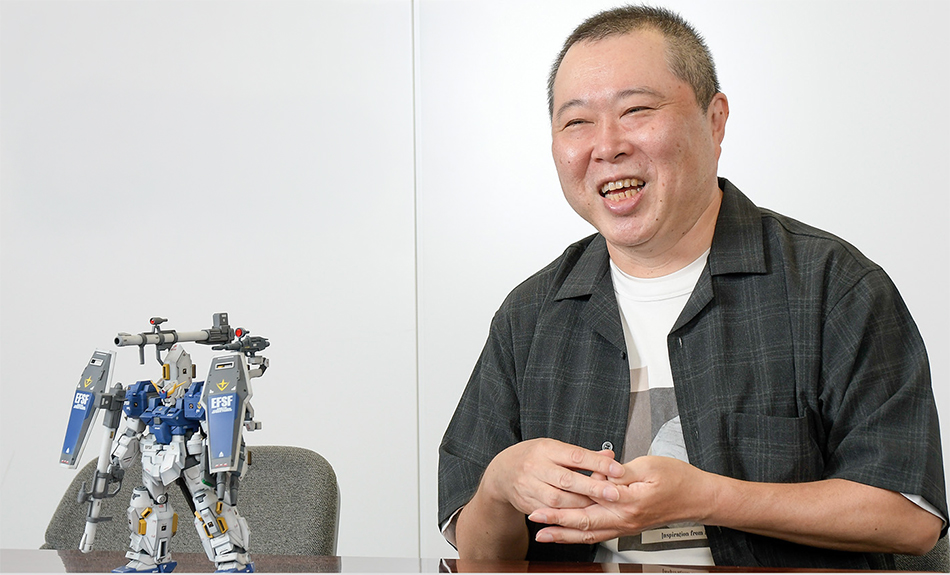
After a monumental thirteen-year serialization, Mobile Suit Gundam Thunderbolt has finally wrapped up. Reading the series back from the beginning, one thing becomes strikingly clear: right up to the final chapter, the drama of Io and Daryl, and of all the people living within each faction, never wavered, not even once. Character, machine, and world lock together seamlessly, and what emerges is a captivating work of entertainment built on the foundation of Gundam. To commemorate the series’ completion, we sat down with creator Yasuo Ohtagaki to hear about what went on behind the scenes of the climax, and how he feels now that it’s all over.
Interview and Text by Hiroyuki Kawai
EXPANDING THE VAST POSSIBILITIES OF THE UNIVERSAL CENTURY AS A STAGE
――The serialization ran for thirteen long years. How did it all begin?
Ohtagaki: This would be about fourteen, fifteen years ago now, I think. Back on the Twitter of that era, what’s now X, there was this movement among manga artists to draw Gundam fan art. I was having a blast drawing Gundam myself, really caught up in the excitement, when out of nowhere Shogakukan approached me and said, “How would you like to draw a manga as a promotional tie-in for Mobile Suit Gundam AGE?” At first they told me, “A one-shot is fine,” but honestly, there’s no way you can do justice to something as massive as Gundam within the scope of a single one-shot. So I told them, “Let me at least try for about one compilation volume’s worth.” But as I was writing the plot, it swelled into something that couldn’t possibly fit in one volume alone. And in the meantime, it turned into a pretty popular piece of content, so the conversation became, “Don’t end it, let’s just keep going.” And that’s how it ended up running for over ten years.
――In the end, it grew into a sweeping saga that engulfed the entire Earth Sphere.
Ohtagaki: Originally, the story of Io and Daryl was supposed to end right there in the Thunderbolt Sector. Continuing beyond that was never part of the plan, not even remotely. After discussing it with my editor, we decided that the first three volumes would function as a prologue, and from there a grand, epic narrative would begin. Never in my wildest dreams did I imagine it would run all the way to volume 27, though… At the point when I was still hashing out Part Two, there wasn’t even the faintest trace of the South Seas Alliance or the Newtype material.
――Looking back now that it’s over, one gets the impression that you were consistently exploring the theme of Newtypes all the way through.
Ohtagaki: When the serialization first started, I intended to end it as a story about ordinary citizens and rank-and-file soldiers. But once you commit to telling an epic saga, Newtypes are a theme you simply cannot dance around. Of course, the Newtypes I depict are different from what Director (Yoshiyuki) Tomino envisions. And as I expanded on my own thinking, I arrived at this conclusion: “There is no weapon more dangerous than this.” Think about it. If, in the middle of your everyday life, you suddenly heard another person’s voice inside your own head, wouldn’t that be a miracle? You would believe in the existence of God, without question, and you’d be powerless to resist it. That’s precisely why a religion that exploits Newtypes struck me as the most terrifying possible use of that power. And out of that idea, Levan Fu and the South Seas Alliance were born.
――The two protagonists were drawn in stark contrast to one another, and in the end their fates were contrasting as well.
Ohtagaki: At its core, the theme of Thunderbolt is contrast. Light and shadow, the strong and the weak, Newtype and Oldtype… Especially in the early going, up through about volume 2, I was switching between Io’s and Daryl’s points of view with every single chapter, depicting them in alternation. That came from a feeling I had toward the readers: “Please don’t decide on your own which one is justice and which one is evil.” I wanted to create the kind of story where your heart synchronizes with both of them, where you can’t help but empathize with both sides. I believe that’s the cruelest aspect of war, so if that theme came through all the way to the end, nothing would make me happier. I mean, wasn’t that the appeal of the original Mobile Suit Gundam in the first place? It broke dramatically away from the old formulas, good triumphing over evil, heroes battling invaders, and explored themes with real depth. Part of what I was doing was an experiment, in a sense, a “What happens if I tackle that theme and approach it through a present-day lens?”
――From Part 2 onward, the story feels far more original. How much freedom did you have to change things?
Ohtagaki: As the Gundam franchise keeps expanding, I think the mindset of “it must be this way” only narrows the content’s possibilities. Before the serialization began in particular, the One Year War was locked into a rigid, fixed conception as a war chronicle. But Gundam history includes an extraordinary outlier like Mobile Fighter G Gundam, doesn’t it? So I thought, surely the One Year War doesn’t have to exist only in the gaps of established history; surely there’s room for something entirely different. “This is a Gundam of a different vein,” that was my mindset from the very start, before I even began. After all, the Universal Century itself is a world built from settings dreamed up by all sorts of different people. There’s a whole history of retconned details accepted into official history, so I felt we didn’t need to be quite so shackled by it.
GUIDING IMPROVISED IDEAS TOWARD DEVELOPMENTS THAT FEEL CONVINCING
――A major turning point in the story was the battle at the Taal Volcano Base. The sinking of the Spartan came as a shock.
Ohtagaki: It came as a shock to me, too! (laughs) When you’re drawing manga, there are moments when the story suddenly lurches off in a direction completely different from what you’d originally planned. The Spartan was exactly that; I never intended to sink her. She was the ship they needed to reach space, and I was drawing her with that in mind. But as I kept going, I found myself thinking, “No, she has to go down here.” And the moment I actually started drawing that development, the pen just took off. In the end, I think it became a tremendously symbolic scene. As an expression of Daryl’s awakening as a Newtype, nothing could have been more fitting than that turn of events. Unlike anime, which is a collaborative medium, manga is a solitary craft, so a great deal of it gets created on the fly. If something feels off, “Hmm, this isn’t right…” you can change course right there. That live, in-the-moment quality is what makes manga wonderful, I think. Though making everything add up afterward is a real headache! (laughs)
――And yet it all looks meticulously calculated. Take, for instance, what became of the recovered Gundam. The way that built into a Gundam-versus-Zeong showdown was brilliant.
Ohtagaki: Partway through the serialization, I became conscious of paying homage to the original Mobile Suit Gundam, and I knew I wanted the finale to be Gundam versus Zeong. But having Io climb back into a Gundam felt too obvious. If you think in terms of that structure of contrasts, it’s far more interesting to put Daryl, now awakened as a Newtype, in the Gundam. And that’s where the idea came from: layer the Gundam over the Psycho Zaku, and you get the Perfect Gundam.
――The Zeong foreshadowing paid off beautifully as well.
Ohtagaki: That one took about seven years to come full circle! (laughs)
――The Gundam docking with the Braw Bro was another huge surprise.
Ohtagaki: One of Thunderbolt’s hidden themes was a personal wish of mine. I want to feature every single mecha that appeared in Mobile Suit Gundam. The Braw Bro, being a Newtype-use machine, was especially tricky to handle.
――It also felt significant that the psycommu system, shrouded in so much mystery, was depicted with such clarity.
Ohtagaki: Across countless works of science fiction, you see that recurring development where a human brain gets used as a component, right? Levan Fu is a clone as well, so I thought, if his face were mounted right there on the machine, it would make the psycommu system feel utterly convincing. When people write science fiction, the worldbuilding often ends up taking the lead, doesn’t it? But the settings aren’t what readers actually want to see. Gundam is full of technical jargon too, but in manga, I feel a duty to simplify things to the point where the story is instantly understandable even if you don’t grasp the lore. Gundam was originally a visual medium, after all, so in a single panel of manga, you have to construct a scene with enough persuasive power to hold its own against film. One image that communicates is worth more than a hundred words of explanation.
TWO PROTAGONISTS, TWO OPPOSING ENDINGS
――Karla’s betrayal at the eleventh hour, that development was a real shock.
Ohtagaki: I’d actually decided fairly early on that the final boss will be Karla. Once she snapped out of that infantile regression and came back to herself, I started thinking about what she would do when she sees the state of the world. Surely, I thought, she would despair at a world still locked in endless slaughter and think, “I’ll smash it all to pieces.” I decided to use her as the joker, the wild card who overturns everything everyone had built up, right at the very end.
――At what stage did you conceive of Karla’s betrayal?
Ohtagaki: The idea itself was already there around the time I was drawing volumes four and five. Whether I could actually steer the story to the development I envisioned, though, that was pure trial and error. I kept laying the groundwork through Karla’s expressions and the things she said. I was hoping that, at the instant of her betrayal, readers would realize, “So that’s what those strange faces and odd remarks were about.”
――The scene where Creed’s Guntank lands a blow against Daryl was incredibly stirring.
Ohtagaki: As I said earlier, it comes back to contrast. If one side of the equation is “the ultimate machine piloted by a Newtype,” then its natural opposite had to be the Guntank. It can’t fly freely; it’s nothing more than a gun platform. If anything was going to land one telling blow against the Perfect Gundam, I wanted it to be the machine most distant from it in every way. If that contrast came through to readers, I’d be delighted.
――There was something deeply tragic about Daryl ending up in an old Zaku.
Ohtagaki: At the end of Mobile Suit Gundam, Amuro says, “I’m sorry, I still do have a place to go home to,” and goes back to his comrades. That scene of Daryl’s is actually a reverse homage to that moment. To me, Daryl is the representative of the ordinary boy. That boy obtained a power far beyond what he was meant to bear, keeps wielding it, and brings about this terrible outcome. With just the slightest misalignment of fate, it all ends in a way with no salvation. Some people said they wanted Daryl to be saved, but I think the moment where Karla holds him in the end is the one piece of salvation he still has left.
――It was certainly an unforgettable scene.
Ohtagaki: When I was around twenty-three, I saw the Pietà in Rome, the sculpture of the Virgin Mary cradling Christ’s body after he was taken down from the cross following the crucifixion. Osamu Tezuka, too, left behind a final concept called Pietà in the Toilet, and the image of the Pietà had stayed somewhere deep in my mind. While I was drawing Daryl’s final panel, wondering how exactly I should do it, I started to feel like it resembled something. Then it hit me: “Ah, it’s a Pietà.” Even I was a little surprised when that image connected.
――In contrast to Daryl, who seized the power of a Newtype, Io became a character who radiates strong bonds with his comrades and family, including in his attitude toward Callisto.
Ohtagaki: That may be a mentality that doesn’t really exist in Japan. American soldiers have a very strong sense of fighting to protect their families and their comrades. Seen from a global perspective, what Io is doing is actually pretty standard behavior. Whether that’s good or bad is another matter, but I do think the way Io acts represents the best kind of landing point for an adult.
――The development where the three of them rent an apartment and live together was surprising in a different way.
Ohtagaki: That one chapter reads bizarrely like a domestic family drama, doesn’t it? (laughs) Though it seems some readers found it unsettling instead, wondering what on earth was going to happen after something like that.
――For mecha fans, the debut of the Thunderbolt Gundam was a bombshell. How did that suit come into being?
Ohtagaki: I had told the editorial department and the editor-in-chief, “For the ending, I want a full volume to devote to the epilogue.” I wanted to draw a final chapter for each of the many characters. And when I asked myself, “What would Io’s final chapter look like?” the answer came immediately. “He’ll probably still be fighting.” The Thunderbolt Gundam is the machine that gives Io his grand final bow. If that’s its purpose, then a mass-production model or an existing machine simply wouldn’t do, it had to be an original. It’s the culmination of every design I’ve drawn across Thunderbolt. I thought of it as one last burst of fireworks launched for all the fans who supported the series for so long. In my own mind, it occupies the position of that world’s ZZ Gundam. I drew it with the mindset of, “If I were the one to draw the ZZ Gundam…”
――And at the very end, a figure who appears to be Scirocco even makes an appearance.
Ohtagaki: I wanted a character who would carry in a premonition, “Something wicked is surely still coming after this…”, and the feeling was, “There’s no one for this but him!” I never imagined there’d be that much reaction to nothing more than his silhouette from behind.
――In a sense, it feels like a happy ending.
Ohtagaki: It is. For Io and his comrades, that is a happy ending. In the end, they arrived at a place where they can make full use of their abilities. It’s exactly that feeling of, “If we’re going to fight anyway, we want to fight with weapons we believe in, in an environment we believe in.” Somewhere deep down, those men still carry something like a code of chivalry; they feel that dying in a grinding war of attrition is not the battlefield they want for themselves. “Let the enemy come at us in their strongest suits, and we’ll meet them in ours!” That connects directly to the romance at the heart of the Gundam universe. For Io and the others to land there, I think that was a fine place for the story to settle, as a Gundam work.
――If you were to draw Gundam again someday, what theme would you want to explore?
Ohtagaki: I poured thirteen years into drawing this, so I can’t imagine anything greater coming out of me now! (laughs) If I did draw something, it would probably be a sidestory in the vein of a Thunderbolt spin-off. Plenty of readers have voiced their hopes for one. Though it’s not something I can do on demand…
――Finally, do you have a message for the fans?
Ohtagaki: The fact that I was able to keep this serialization going for thirteen long years is truly thanks to the support of all the fans. Being able to keep creating this work while trading back and forth with readers, tossing ideas around, has become an enormous treasure in my life. The manga’s serialization may be finished, but the anime remains paused at Season 2. Personally, I dearly hope it will be adapted all the way to the end. And for that reason too, I’d be grateful if everyone who loves this work would continue to make their voices heard. Thunderbolt is not over yet. I hope the series will grow even livelier from here. To everyone who cheered us on through all these years, thank you, truly, from the bottom of my heart. And I hope you’ll continue supporting Thunderbolt in the future as well!
Source: HJ Mechanics 28, June 2026 (pages046-047)