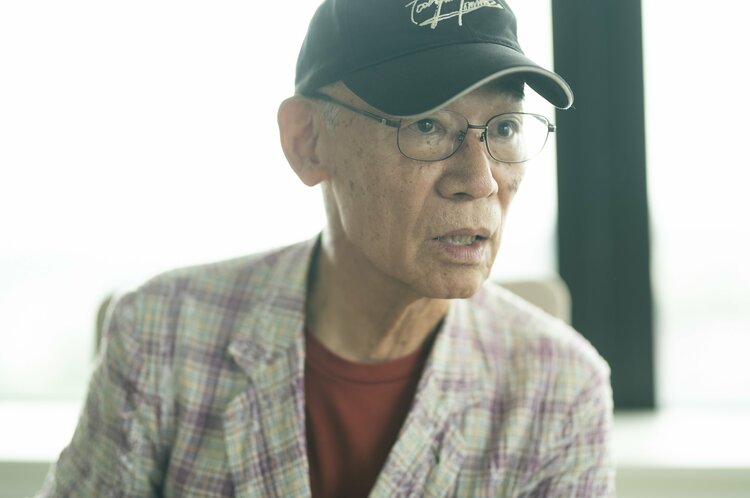
YOSHIYUKI TOMINO’S THE CHANGE #1
In 1979, with Mobile Suit Gundam, Director Yoshiyuki Tomino brought a new genre of realism to the world of robot anime. Even at 82, he continues to challenge the forefront of animation. But from where does his seemingly boundless creativity spring? We delved into Tomino’s “THE CHANGE” in the conference room of White Base at Bandai Namco Filmworks in Suginami, Tokyo.
YOSHIYUKI TOMINO’S “THE CHANGE” #1
(Interview Series 1 of 5)
When Director Tomino appeared at the interview location, his gaze fixed intently on the blue hourglass sitting on the desk. The hourglass is the symbol of Futabasha THE CHANGE, and when we explained our intent, that we wanted like to photograph him together with it, Director Tomino offered a single remark.
“Then you should turn it into a character. Stick two circles on it and you’ve got eyeballs, don’t you?”
And so the interview began, with a firsthand glimpse of a director whose mind is always, always on characters.

■ “Things of flesh and blood have a softness to them somewhere”
The dizzying advance of AI (artificial intelligence) has been drawing attention in every field of late. This February, Netflix stirred conversation by releasing The Dog & The Boy, an experimental short that used AI-generated imagery for the backgrounds of every single cut. Faced with that kind of CHANGE in the entertainment industry, how does Director Tomino see it?
“We’ve become a digital society, tools like ChatGPT have appeared, and we’re already in an age where people say, ‘There’s no need to look anything up anymore, is there?’ And fine, the people who are made to write ‘Thank you for your continued support’ day after day after day without ever tiring of it, those people should absolutely use ChatGPT. But if someone is using that tool to think up creative work, that person won’t last ten years. Because the sources will presumably be identifiable, and everyone will come to see right through it, ‘The polish on this prose is AI, isn’t it, my friend?’… Right now the Hollywood writers’ union is making a great commotion over ChatGPT and copyright, but me, I don’t think that’s much of a threat.”
――Meaning it will never become anything comparable to the creative works we’ve had until now?
“It won’t. Because there’s the question of how far ChatGPT can actually read what a living, flesh-and-blood human being puts out. That thing is data-theory, isn’t it? Its route is to judge data, aggregate it, and produce an answer, so there’s a part of it that feels hard, rigid, to me. Things of flesh and blood have a softness to them somewhere.”
――I see.
“I’d like to put this a bit more clearly, but it’s such a bothersome subject that I can’t even tell whether it’ll be easy to understand unless you’ve experienced it. (A brief silence.) I’m talking about sex.”
■ “A novel written by ChatGPT would be, to put it bluntly, ‘cheap ass erotica'”
――Sex?
“That’s right. Sex. A person who only looks at porn and erotic comics on the internet, and a person who knows what it is to feel good in real sex, the tone of the two is completely, utterly different. So, for example, a novel that would be written by ChatGPT is, to put it bluntly, ‘cheap ass erotica.’ A bargain-bin porno paperback. I think that stench would come through. Human sensitivity is actually razor-sharp. We sniff that difference out.”
――I see. Is that so?
“It is so. And you, (turning to the reporter), I got the feeling you don’t have that sensitivity. Hearing the way you respond, your language feels cheap, so I imagine someone like you probably wouldn’t notice that smell.”
――So I’d be fooled by the AI, then.
■ A reality thrust upon him by a film he happened to see the morning of the interview
In Tomino’s works, romance between men and women unfolds amid wars fought with robots. And it isn’t only in explicit scenes; it also lives in the suggestive traces left in dialogue and movement, in the relationships the viewer is made to imagine from passing gestures and fragments of speech. It is likely that those very elements are what Director Tomino means when he speaks of a “smell” that AI cannot write. Throughout the interview that day, Director Tomino returned again and again to the idea that in creation, “experience” matters above all else. And that doesn’t mean lived experience alone. Even now, at eighty-two, it applies just as unchangingly to the act of “seeing.”
“If someone has even one memory in life of truly monumental sex, they may not need a second time. Apparently, there are experiences of sex so complete they seem to fill up an entire life. And this ‘apparently there are such things…’ I was told that by a film I happened to see this morning, and to be honest, right now, it’s given me chills.”
The work that gave Director Tomino “chills” is Two English Girls (Les Deux Anglaises et le Continent), the 1971 French film directed by François Truffaut.
“I woke up before six this morning, and I just happened to catch this film that started at six on the movie channel. At first it was a little hard to watch, and I thought, ugh, I don’t like this, but I ended up watching to the very end, and it left me completely speechless. The main thread of the story: the younger sister, a woman called Muriel, was a virgin until thirty, and she gives herself to her lover. And then the very next day, she says, ‘Now that this is done, it’s over between us. Last night truly felt wonderful. With this, I have buried my love.’ She has sex exactly once, and with it buries her love, and the film goes on to depict what comes after.”
The film was adapted from Henri-Pierre Roché’s novel The Two English Girls and the Continent. Directed by Truffaut, it portrays a triangle among the English sisters Anne and Muriel and a French young man named Claude. The film includes a scene depicting Muriel’s first night, and while its images are beautiful, it also drew attention for the sensational nature of what it showed.
“She’s a Puritan living deep in the English countryside, brought up under extraordinarily severe principles. And so both the younger sister and the older one remained chaste, serious women right up into their thirties. That background is there, of course. But there is one thing a man absolutely has to understand in this story. A man thinks, ‘No such woman could possibly exist!’ But women, it seems, are different. It’s a story that says this can happen. And a man can never, ever imagine it.”
――Just that one time, with the man she loved.
“Exactly. ‘Last night felt wonderful, and with that, it’s over’… Now wait just a minute! (bangs on the table, bam, bam, bam). And yet, when you watch the film, there’s this lingering resonance, you can feel that afterward, she really did go on and live exactly that way. The actress herself, you see, she makes you believe it.”
■ “By looking only at what you like, you end up narrowing your own field of vision”
From a single film he happened to catch in the early morning, Director Tomino had drawn out an entirely new realization. Where did he cultivate that kind of flexibility in the way he sees things?
“The way people think now, they casually say things like, ‘This is my justice,’ or ‘This is the profession that suits me,’ or ‘This is what I like.’ But what that really means is that they are constantly narrowing themselves. If you narrow your own field of vision with your own hands, then what ‘change’ can there possibly be? One of the bad things about social media is that people look only at what they already like. And if that’s all you do, your field of vision shrinks. There are prodigy children, six or seven years old, who are skaters or pianists or violinists or acting in dramas, but children like that are vanishingly few, aren’t they? The average child has only a certain measure of ability, and isn’t it far more common for a child to have nothing in particular they even want to do? So what should a child like that do? If they land a workplace at all, they should count themselves lucky, and rather than agonizing over ‘the career that suits me,’ what matters is thinking about how to adapt themselves to the workplace they’ve got.”
In today’s interview, Director Tomino looked back over his own past work: “I was never anime-oriented to begin with. I carry a sense of defeat about Gundam.”
That unsparing eye, turned even upon himself, may be precisely the posture that gives birth to “change,” the secret of creation that belongs to Yoshiyuki Tomino alone.